Friday, April 18, 2008

Thursday, April 17, 2008

Wednesday, April 16, 2008
Monday, April 14, 2008
Photographs From The Collection Of Gert Elfering, Christies, New York
- the assumption i had with regards to the market falling apart sort of collapsed with the most recent photo auctions, with work going for twice or three times its low estimates, even for work reprinted in larger editions for later work (ie avedon of bacall, shot in 1968, printed in 1980, edition of 50, 147k, 3x the estimate) (another avedon, his iconic photo of bardot, shot in the late 50s printed later, double the estimate) (less of an edition, but a penn photo of a cigarette in lips, shot in 61, printedin 1981, for 67000, more then 2x the estimate) (the 1984 print of Frozen Foods, edition of 33 is rising and rising and rising, low 6 figures here)
- in the market, the former critical split b/w art and fashion work has basically disappeared
- this collection, is all big names, not really famous photographers, glamour, high gloss, basic work, and even if it has a large collection of nudes, it doesn't even have the honour of a private porn stash
- leni refienstahl's photos of massai warrors, two of which sold here, are weirldy, in their exoticizing power, and copereal fetish, more racist then the nazi work
- in this context, it is curious how ironic ruff's work is meant, in with other nudes, it is a straight study, in wiht other conceptualists, it becomes an ironic detachment
- two la chapelles for 27k and 29k about, respectivley, that the lower one is a nude of naomi campbell suggests the prices are low.
- there arent any really great photos in this collection, iconic work, and pervy work, and occasinaly a pervy work that manages to be iconic, but nothing really strange, and the work that managed to play midas--that first lady of france tabloid thing, just proves that you can be vulgar even if you have bad tits.
- 21 bought in, out of 135
- this collector shopped for adams, like shopping for a wardrobe in lands end
- again, most of the prints are the mid to late 70s editions, after the swaorkaski dictated rise in high market photo work (the complicated realtionship of collectors, and the new york graphic society, and that some of the portfolios come from there, strenghten this thesis. (and anyone who pays 481,000 for an edition from 75 shot in 44) (or 421k for an edition from 75 shot in 48) is a moron
- has anyone read ansel thru the window of church
- ansel can shoot, even on the machine, his prints are luminous and his compositions are are extremely deliberate.
- 19 out of 122 bought in.
- i always wonder what the implications are for conceptual or process work ending up as photographs, the taxonomy of it, esp with people like christo, where photos are part of a larger work, why are the drawings in the m/c auctions but the photos (ghettoized?) (also accocini)
- Nan Goldin's formal work is really fantastic sometimes, her French Chris on the convertible, N.Y.C, sold for 12,5, uses the aqua teal of an open car hood, as a background for a v. pale man, ina white shirt and pants, laying on his back, across it. there is dark street behind the man and the car--the darkness, the whiteness, the colour of the car trunk, an almost perfect triangualr compositon (also, weirdly a peita, the car hood a virigin mary blue, the white of the flesh, marbelsque, the pose, etc)
- i wonder if the high prices for sternfield's disaster photos, negativley impact his more prosiac work (ie a late printing of mclean virgina, the firefighter/pumpkin photo sold for 43k, while a better series of 8, including an almost perfect pick up truck photo, bought in)
- if auctions work as a pedagogical tool, as both christies and sothebys suggest, what does it mean that the same 5 or 10 photographs show up at every photo session, often one or two images begin to define a photographer with a long career (the henry callahan photo of elenor in the lake, is the one that cuased this comment, cartier bresson's bike rider is the other one
- penn continues to be over valued, with the simplest work, going for the most cash
- what is karsh's larger rep these days? all of the work at this auction goes unsold
- best deal--egglestons southern suite, 269k for 10
- 70 of 228 unsold, including sterfnfield, curtis, ruth orkin, arbus (including gernade), evans (including one from the subway series), several Mapplethorpes (mostly florals), a Brassai, an AVedon, Charles Jones leeks, and an Eggleston
- a few unusal or rare works, including a coney island house of horror, but most of the common ones, disneyland's castle, midgets, nudists, the 1978 photos at the Down's community. (though Child selling plastic orchids at night, N.Y.C. sold for 163k)
- though they are again, later impressions, the work from the mid 50s, not the magazine work, but the other work, is under selling, and exquisite, beautiful even. a qaulity that would corrupt over time. (thesis: arbus never lost her formal skill or the tenderness she felt for her subjects, but as she felt more and more like an outlier, the work took those classical skills, and merged it with this kind of populist freak sensiblity--sort of like what you see in velasquez's dwarf.)
- she is also one of the great photographers of adolsecence, which might add evidence to the outlier philosophy, there is a narrative in this collection, of children smoking, selling flowers, in blackface,dancing, at a pro america rally, as a couple, that suggests teenages, that have an awkardness that destablizes the rock and roll rebel work done by other photogs of teens, the work were v. well chosen, well curated.
- none (!) bought in
- three solo photo collections this year, arbus, adams, and weston, does this mean anything
- brett weston was not a v. good photographer.
- defintely a qauntity over qaulity situtation, esp with a ridicuolous excess of adams and slightly less ridiciolous excess of evans
- i should know charles hudson white shouldnt i
- a boring and historical evening, with no real masterpieces, and a lot of the expected
- why would you enlarge polaroids, of road markings, the smallness and the intamicy of it seems to be the point
- 19 out of 228 works bought in.
Saturday, April 12, 2008
Friday, April 11, 2008
Thursday, April 10, 2008
Wednesday, April 09, 2008
Upgrade This?
1. My friend Ted was talking about how Justin Timberlake instead of Madonna as the new Britney--it is a strong thesis, which I think rests of the erotic ease that both contribute (i.e. the work is disguised, the ease and the suave is pulled to the forefront) Madonna has always made her politics more explicit though
2. I said to teed that it's also about Nashville, both soul and country came out of Nashville, and for the first time since the 70s we have a few significant pop workers, who know the semiotics of both hip hop and r/b...JT is the biggest of those
3. It might also be the robot, the assuming of the robotic, and the realizing that the denial of self is not nessc. coincidental with the denial of voice. (I.e. one of the saddest, and most humane songs of the last 5 years, is the vocodered hell of technologic by daft punk because it seems to be not only talking about the nature of music, but the nature of humans, the narrative implied in that song, is the narrative of Justin Timberlake an the narrative of pop post 2000--i.e. Buy it, use it, break it, fix it,
Trash it, change it, (Mail) - upgrade it,
Charge it, (Point) it, zoom it, press it,
Snap it, work it, quick - erase it,
Write it, cut it, paste it, save it,
Load it, check it, quick - rewrite it,
Plug it, play it, burn it, rip it,
Drag and drop it, zip - unzip it,
Lock it, fill it, call it, find it,
View it, code it, jam - unlock it,
Surf it, scroll it, (Pause) it, click it,
Cross it, crack it, (Switch)- update it,
Name it, read it, tune it, print it,
Scan it, send it, fax - rename it,
Touch it, bring it, pay it, watch it,
Turn it, leave it, stop - format it)
4. He bought the samples, he used the samples, he upgraded his world from Lou Perelman to Britney, from Britney to Madonna, he called the right producers, he made music that was a careful and elegant bricolage of American soul, country, r and b, hip hop, it was the smoothness, the robotic delight, that made him a star...(its also why the Martin Luther King Junior line in Beyonce's upgrade this doesn't jar, because the physical and the meta physical are one, the martin doing to the people, the ring as a tumor, and let me upgrade you, mutually destructive instincts smoothed over to something pretty leading to the upgrading as status (c/c with Kayne's diamonds of Sierra Leone and Gold Digger) , is a computerized hope for the America dream, so a boy from Nashville and a girl from Houston become king and queen of upgrade pop (except Beyonce's daddy was a record producer, so maybe her life was already planned--its tough to know who's ambition is who's on the road to the top, and JT's success is to successfully hold the middle when everything else goes tits up.)
5. Maybe its also a revision of the old chuck berry line--the men don’t know but he little girls understand, except its the men know, the little girls understand, the pop sugar feasts and the indie kids dance.
6. Which means you listen to Justin Timberlake, no matter what, you listen to him, if all the disco you can stomach is LCD Soundsystem (not that LCD Soundsystem isn't genius, but its a different kind of genius, disco always had a kind of faded glamour, a keep dancing fast enough they wont take it away from us vibe, and JT is convinced that nothing will ever go away, LCD Soundsystem is the ersatz, exhausted, lets fuck shit up, because we are already fucked up--its the depressive coda of the simple pleasures that JT loves--or to put it in another way, its the system crash of the upgrade we are talking about earlier, break's Asimov’s third law: A robot must protect its own existence as long as such protection does not conflict with the First or Second Law. Pop will eat itself, but it will never die, and to point out its sadness is to point out its logical inconsistencies.
7. Which sort of brings me to Timbaland's solo album--you can hear Timbaland directly and indirectly all over this shit, he is the originator and the survivor of this aesthetic, of the throw everything to the wall, of the super processed, of the vocodored, of the nu-ryhtym nation, of the upgrade this. The solo album, which I don't think sold as well as it should have, and was as collaborative enough to be almost not be a solo album (i.e. it included guest artists on nearly every track, from Nina Simone, to Missy Elliot, from the Hives to M.I.A but the two most relevant to the subject of this essay, are Elton John and the previously discussed Justin Timberlake and Elton John
8. Elton John, with his brown cowboy work from the 70s, and his peach tree road stuff from the 90s, is one of the connectors’ b/w the south, the north and Europe, and we are talking about the intersections b/w the north (Detroit/New York), Europe (France/ England) and the south (Atlanta, Houston, Nashville)
9. The interesting thing, or one of the interesting things, that Timbaland does to the Elton track, is he strips the words, Elton’s words are a weird combination of hyper sincerity and bullshit hype, of the depth of emotion and the flatness of surface—so to take all of the emotion out of it, and to make the piano do the hard work, is to figure out what a hook does, what a beat does, what a break does, what words do in their absence, its an act of essentialism, of four/four beats extending to their logical limits.
10. It recasts pop history as one that is against language, the ripping apart, the working through of history that has been timberlands project, cuts through the narratives of Daniel or rocket man. The stuttering start, and the slow extension and then retraction of keyboard, waiting, waiting for the voice, and then the voice absent, listening to the end, a name check, and virtuoso's on the 88 keys--like Scott Joplin or Jerry Lee Lewis or Screaming Jay Hawkins or Kate Bush, all are here, in the staccato, and the rhythm versus percussion polyphony fight that makes up pop in general. That it is the last non-bonus song on the album makes it a tying up, for an album that is chaotic, collaborative, abstract, and difficult.
11. So it is the opposite, then of Elton, of Beyonce, of JT, of all the people we are talking about—the talent then of Timbaland, the part of the upgrade that is the most valuable is to make discordant ideas synthesize, and by picking out individual ideas, the history o the ideas, it breaks the illusion, it causes the robot to blow smoke out of its ears.
12. To upgrade though, is to have work from the beginning, to have something to synthesize from, and to synthesize to. So Timbaland working on his own, as opposed to a high powered consultant for heeled clients, recognizes the slickness of the ideas being talked about, he overstays his welcome by indicating the mechanics of pop which is strange, because this is a genre that would seem to have all of the meta issues sorted out or transparent. We are living in an age where he slickness of surface and the earnestness of the heart, the mutually destructive appetites of brain and loin are placed on the table for mechanical analysis. He scatters his report though, and doesn’t even treat it like one---his work with john (and it is even unclear if John is alive or mechanized here) shows the consequences of upgrading.
13. If Timbaland is the motherfucker at the corner of the party, playing too cool and together, understanding too much about the process to be truly involved, then Britney is the whole island of broken toys. Her work was always too human, too delicate to be truly robotic. Lonely and isolated, it’s cognitive dissonance was the exact opposite of the sleekness of JT or the self aware earnestness of Kayne, or the eroticized coldness of Beyonce (side note: Beyonce should really push to cover Grace Jones pull up to the bumper baby the studio has made so many advancements, and she could make it sound less efficient). The secret (or at least under spoken narrative about Britney is that of the machine taking over—she has become more mechanized and less human the more she has fallen apart.) That is a 20th century narrative, of the robots taking over, or being a robot instead of a human, it is the horror of technology found in Metropolis, in 2001, in Ballard’s Crash or the Atrocity Exhibition, in Summer Toys Last All Day Long, or the Terminator. Britney is no longer popular, because she is not cybernetic, because she is fearful of the robot taking over her body. The consensual merging of body and technology is nowhere to be found in her work.
14. Her first number one hit, is hit me baby one more time, processed to all hell, but human, and historically girl pop, with hints of The Crystal’s He Hit Me and It Felt Like A Kiss. Her voice is slight, but not delicate, beautiful and adolescent. It contains a short but significant piano motif, which is not bombastic, or cut apart, and is very clearly an acoustic instrument. Born to Make You Happy is a ballad about her loneliness and her sadness. Lyrically attached to Carole King, with a definite electronic beat, but which once again contrasting once again on her natural, can ignore, teenage girl voice. Oops I Did I Again, starts with space noises, and the video features a narrative from Mars, Britney makes her self an alien, literally. The first major electronic manipulation of vocals. Lucky, profoundly nostalgic, but nostalgic for a time she could not remember, self-consciously meta, and ironic, disassociate. The narrative begins to tip from the music of Britney to the consciousness of Britney. The upgrade starts. Me Against the Music—the Madonna single, who knows the pop music history, and who has flirted with becoming a robot since the mid 80s, growing into a maternal figure, the discussion becomes who will be her successor, she stages an event seemingly out of H Rider Haggard at that years MTV Video Music Awards, with Britney and her pop rival Xtina in dresses, kissing Madonna in Black Leather. That Xtina retreats into literal Burlesque, making herself over into Doris Day for the neo-retro crowd, and Britney falls deeper into madness. Madonna latter realizes her successor will be one who synthesizes better then he creates, namely JT. Toxic—avant noise, and genuinely separate from Britney’s other work, the harshness will be tamed by people like Rhianna and Beyonce, It is also one of the most profoundly self loathing songs, the self awareness, and the terror of losing control is profound. That it is now more electronic then human, and that the voice found in her earlier work is now lost, is clear. Everytime, this would be the one that would disprove my thesis, a beautiful and fluttering ballad, with a genuine piano and almost no electronic effects. But the video ends with her suicide, any attempts to be a pop star leads to destruction, the desire to be full with the pleasure of music cannot be found here. The robot is not the literal mechanical voice, the too pure production, but the ability, to, in the words of Marianne Faithful “slide through life on charm” That Britney’s last album was so chaotic, so broken, the exact opposite of the new trends for hermetic sealing of emotion into semiotic deconstructions of desire. That Britney has to name herself, that she begins the album by the almost fetishistic naming of self, is the exact opposite of the third person pseudo humility found in the works mentioned. Britney cannot upgrade this, because she is essentially human, and to upgrade is essentially anti-human.
14. Which is not to suggest that there is work that manages the aesthetic of upgrade pop, but whose lyrics integrate an unstable narrative. The most explicit of these is Kayne West’s Stronger, a work so dense with contradiction and complexity that it risks being not heard at all. Beginning with a Daft Punk motto:
Work it harder make it better,
Do it faster makes us stronger,
More than ever, hour after hour,
Work is never over, sung through out, as sung by faceless vocoders. Which seems to be a condensation of thru a lens of Nietzsche, it combines themes of sexual athleticism, the prosperity gospel, pure ego, nostalgia, and label dropping high commerce, envy, and authenticity. The song is so dense, so self contradictory, that the speed, and smoothness of Kanye’s flow are the only thing that prevents the whole thing collapsing into it’s own interior contradiction. The charisma and devotion to aesthetics of Warholian surface mean that the audience does not unpack words like:
Heard they do anything for a Klondike,
Well, I'd do anything for a blonde dyke.
Those 16 words have all of the positives, and all of the negatives expected of hip-hop, and of upgrade pop as well. They are literally dense, packed so tightly into the structure of the song that pulling them apart is like pulling one string out of a sweater. They combine desperate pleasures, have an incongruous rhyme, and an elegance of form that matches Herrick or Marvell in its rakish wit. It is also homophobic, and misogynist, assuming that owning women, and converting women are the rewards for fame. That he keeps talking about how this deeply artificial, almost baroque construction of social, cultural, and religious referents are about being as natural as possible, one is reminded of the gang of four’s the natural’s not it: “the problem of pleasure/is what to do for leisure” –these works are not boring, they are the opposite of boring, but they maintain a kind of louche insistence on seen it all and done it all, with women, with men, with purchases, and with locations.
15. Listening to it live in concert with Justin Timberlake and Kanye—that JT is able to keep up with the speed, with the artifice, and with the combination of aesthetic and spiritual under texts, is to appreciate how much goes on under seemingly placid waters. Even the age difference—Kanye writes about how “I’ve been on you since Prince was on Appollonia” or since “OJ wears Isotoners”. JT would have been born before those cultural touchstones, but age matters less then the elegance of desire. Evensongs about political eruption or emotional meltdown are more about the nature of he song’s construction then the emotions themselves. The assumption that the separation of emotion from source, means less emotion, must be avoided however. The emotional coldness of JT’s Cry me a river, or the meta-contextual awareness that he is creating a love song, makes a song so over wrought, creating a maze of real emotion, expected emotion, historical emotion (is he quoting Julie London?), assumed history outside the text ((is he really talking about Britney) and distance (who is saying I guess I must be leaving)—the video, with its voyeuristic under currents and its LA modernism, that hides in plain sight, has a dark and penetrating voyeurism. The song’s artifice, its blankness, and its obsessive over production, indicate that the upgrade can be used as a gloss, as a way to paint over scandal, to burry bodies under slick concrete. The same can be found in the more problematic Diamonds from Sierra Leone. This is a man who lauded Jacob the Jeweler, who had Christ with a Crown of Thorns made as a bling-pendant, who loved money with out guilt. But he creates a 6-minute opus, about what it means to love those diamonds—what the hip-hop community has done to Africa, in loving that excess. Starting with the tinkling piano that is meant to indicate seriousness, then strings that stab, like the score to psycho, using a symbol from Shirley Bassey’s Diamond is Forever, he combines drama, luxury, desire and violence in the first five seconds—once again it is packed. The first verse is a selfish desire to keep all other luxury, that only diamonds are attached to a kind of eternal suffering. Once again, the density, the obsessive, rude mechanical that packs moral and aesthetic signifiers, the assumption that technical acuity, all make the essential message, a wariness of late capitals exploitation, more real. The irony, then, to revel in artifice, to revel in the precise combining of historically relevant tropes, means that the message is not hidden but emerges slowly, like a strip tease from Lucille St. Cyr.
16. What conclusions can we draw? They seem like simple ones, ones that we have learnt before—that he operatic extenuates emotion rather then dismisses it, that smooth surfaces do not mean placid depths, that to be human is to be suspect, in a tecnophillic world, that dancing quick enough means the audience is suspected, that an object of great care and beauty can conceal more easily, contradictions, that just because it looks pure does not mean that it is poison, and that which looks perfect, is often corrupt. To pay close attention to texts that seem so sleek, that slide by without the unpacking, is also needed. JT is famous because of that sleekness, because of that slipperiness; Kanye is famous for similar reasons. Not to say they shouldn’t be, but be careful if you really need the upgrade.
1. My friend Ted was talking about how Justin Timberlake instead of Madonna as the new Britney--it is a strong thesis, which I think rests of the erotic ease that both contribute (i.e. the work is disguised, the ease and the suave is pulled to the forefront) Madonna has always made her politics more explicit though
2. I said to teed that it's also about Nashville, both soul and country came out of Nashville, and for the first time since the 70s we have a few significant pop workers, who know the semiotics of both hip hop and r/b...JT is the biggest of those
3. It might also be the robot, the assuming of the robotic, and the realizing that the denial of self is not nessc. coincidental with the denial of voice. (I.e. one of the saddest, and most humane songs of the last 5 years, is the vocodered hell of technologic by daft punk because it seems to be not only talking about the nature of music, but the nature of humans, the narrative implied in that song, is the narrative of Justin Timberlake an the narrative of pop post 2000--i.e. Buy it, use it, break it, fix it,
Trash it, change it, (Mail) - upgrade it,
Charge it, (Point) it, zoom it, press it,
Snap it, work it, quick - erase it,
Write it, cut it, paste it, save it,
Load it, check it, quick - rewrite it,
Plug it, play it, burn it, rip it,
Drag and drop it, zip - unzip it,
Lock it, fill it, call it, find it,
View it, code it, jam - unlock it,
Surf it, scroll it, (Pause) it, click it,
Cross it, crack it, (Switch)- update it,
Name it, read it, tune it, print it,
Scan it, send it, fax - rename it,
Touch it, bring it, pay it, watch it,
Turn it, leave it, stop - format it)
4. He bought the samples, he used the samples, he upgraded his world from Lou Perelman to Britney, from Britney to Madonna, he called the right producers, he made music that was a careful and elegant bricolage of American soul, country, r and b, hip hop, it was the smoothness, the robotic delight, that made him a star...(its also why the Martin Luther King Junior line in Beyonce's upgrade this doesn't jar, because the physical and the meta physical are one, the martin doing to the people, the ring as a tumor, and let me upgrade you, mutually destructive instincts smoothed over to something pretty leading to the upgrading as status (c/c with Kayne's diamonds of Sierra Leone and Gold Digger) , is a computerized hope for the America dream, so a boy from Nashville and a girl from Houston become king and queen of upgrade pop (except Beyonce's daddy was a record producer, so maybe her life was already planned--its tough to know who's ambition is who's on the road to the top, and JT's success is to successfully hold the middle when everything else goes tits up.)
5. Maybe its also a revision of the old chuck berry line--the men don’t know but he little girls understand, except its the men know, the little girls understand, the pop sugar feasts and the indie kids dance.
6. Which means you listen to Justin Timberlake, no matter what, you listen to him, if all the disco you can stomach is LCD Soundsystem (not that LCD Soundsystem isn't genius, but its a different kind of genius, disco always had a kind of faded glamour, a keep dancing fast enough they wont take it away from us vibe, and JT is convinced that nothing will ever go away, LCD Soundsystem is the ersatz, exhausted, lets fuck shit up, because we are already fucked up--its the depressive coda of the simple pleasures that JT loves--or to put it in another way, its the system crash of the upgrade we are talking about earlier, break's Asimov’s third law: A robot must protect its own existence as long as such protection does not conflict with the First or Second Law. Pop will eat itself, but it will never die, and to point out its sadness is to point out its logical inconsistencies.
7. Which sort of brings me to Timbaland's solo album--you can hear Timbaland directly and indirectly all over this shit, he is the originator and the survivor of this aesthetic, of the throw everything to the wall, of the super processed, of the vocodored, of the nu-ryhtym nation, of the upgrade this. The solo album, which I don't think sold as well as it should have, and was as collaborative enough to be almost not be a solo album (i.e. it included guest artists on nearly every track, from Nina Simone, to Missy Elliot, from the Hives to M.I.A but the two most relevant to the subject of this essay, are Elton John and the previously discussed Justin Timberlake and Elton John
8. Elton John, with his brown cowboy work from the 70s, and his peach tree road stuff from the 90s, is one of the connectors’ b/w the south, the north and Europe, and we are talking about the intersections b/w the north (Detroit/New York), Europe (France/ England) and the south (Atlanta, Houston, Nashville)
9. The interesting thing, or one of the interesting things, that Timbaland does to the Elton track, is he strips the words, Elton’s words are a weird combination of hyper sincerity and bullshit hype, of the depth of emotion and the flatness of surface—so to take all of the emotion out of it, and to make the piano do the hard work, is to figure out what a hook does, what a beat does, what a break does, what words do in their absence, its an act of essentialism, of four/four beats extending to their logical limits.
10. It recasts pop history as one that is against language, the ripping apart, the working through of history that has been timberlands project, cuts through the narratives of Daniel or rocket man. The stuttering start, and the slow extension and then retraction of keyboard, waiting, waiting for the voice, and then the voice absent, listening to the end, a name check, and virtuoso's on the 88 keys--like Scott Joplin or Jerry Lee Lewis or Screaming Jay Hawkins or Kate Bush, all are here, in the staccato, and the rhythm versus percussion polyphony fight that makes up pop in general. That it is the last non-bonus song on the album makes it a tying up, for an album that is chaotic, collaborative, abstract, and difficult.
11. So it is the opposite, then of Elton, of Beyonce, of JT, of all the people we are talking about—the talent then of Timbaland, the part of the upgrade that is the most valuable is to make discordant ideas synthesize, and by picking out individual ideas, the history o the ideas, it breaks the illusion, it causes the robot to blow smoke out of its ears.
12. To upgrade though, is to have work from the beginning, to have something to synthesize from, and to synthesize to. So Timbaland working on his own, as opposed to a high powered consultant for heeled clients, recognizes the slickness of the ideas being talked about, he overstays his welcome by indicating the mechanics of pop which is strange, because this is a genre that would seem to have all of the meta issues sorted out or transparent. We are living in an age where he slickness of surface and the earnestness of the heart, the mutually destructive appetites of brain and loin are placed on the table for mechanical analysis. He scatters his report though, and doesn’t even treat it like one---his work with john (and it is even unclear if John is alive or mechanized here) shows the consequences of upgrading.
13. If Timbaland is the motherfucker at the corner of the party, playing too cool and together, understanding too much about the process to be truly involved, then Britney is the whole island of broken toys. Her work was always too human, too delicate to be truly robotic. Lonely and isolated, it’s cognitive dissonance was the exact opposite of the sleekness of JT or the self aware earnestness of Kayne, or the eroticized coldness of Beyonce (side note: Beyonce should really push to cover Grace Jones pull up to the bumper baby the studio has made so many advancements, and she could make it sound less efficient). The secret (or at least under spoken narrative about Britney is that of the machine taking over—she has become more mechanized and less human the more she has fallen apart.) That is a 20th century narrative, of the robots taking over, or being a robot instead of a human, it is the horror of technology found in Metropolis, in 2001, in Ballard’s Crash or the Atrocity Exhibition, in Summer Toys Last All Day Long, or the Terminator. Britney is no longer popular, because she is not cybernetic, because she is fearful of the robot taking over her body. The consensual merging of body and technology is nowhere to be found in her work.
14. Her first number one hit, is hit me baby one more time, processed to all hell, but human, and historically girl pop, with hints of The Crystal’s He Hit Me and It Felt Like A Kiss. Her voice is slight, but not delicate, beautiful and adolescent. It contains a short but significant piano motif, which is not bombastic, or cut apart, and is very clearly an acoustic instrument. Born to Make You Happy is a ballad about her loneliness and her sadness. Lyrically attached to Carole King, with a definite electronic beat, but which once again contrasting once again on her natural, can ignore, teenage girl voice. Oops I Did I Again, starts with space noises, and the video features a narrative from Mars, Britney makes her self an alien, literally. The first major electronic manipulation of vocals. Lucky, profoundly nostalgic, but nostalgic for a time she could not remember, self-consciously meta, and ironic, disassociate. The narrative begins to tip from the music of Britney to the consciousness of Britney. The upgrade starts. Me Against the Music—the Madonna single, who knows the pop music history, and who has flirted with becoming a robot since the mid 80s, growing into a maternal figure, the discussion becomes who will be her successor, she stages an event seemingly out of H Rider Haggard at that years MTV Video Music Awards, with Britney and her pop rival Xtina in dresses, kissing Madonna in Black Leather. That Xtina retreats into literal Burlesque, making herself over into Doris Day for the neo-retro crowd, and Britney falls deeper into madness. Madonna latter realizes her successor will be one who synthesizes better then he creates, namely JT. Toxic—avant noise, and genuinely separate from Britney’s other work, the harshness will be tamed by people like Rhianna and Beyonce, It is also one of the most profoundly self loathing songs, the self awareness, and the terror of losing control is profound. That it is now more electronic then human, and that the voice found in her earlier work is now lost, is clear. Everytime, this would be the one that would disprove my thesis, a beautiful and fluttering ballad, with a genuine piano and almost no electronic effects. But the video ends with her suicide, any attempts to be a pop star leads to destruction, the desire to be full with the pleasure of music cannot be found here. The robot is not the literal mechanical voice, the too pure production, but the ability, to, in the words of Marianne Faithful “slide through life on charm” That Britney’s last album was so chaotic, so broken, the exact opposite of the new trends for hermetic sealing of emotion into semiotic deconstructions of desire. That Britney has to name herself, that she begins the album by the almost fetishistic naming of self, is the exact opposite of the third person pseudo humility found in the works mentioned. Britney cannot upgrade this, because she is essentially human, and to upgrade is essentially anti-human.
14. Which is not to suggest that there is work that manages the aesthetic of upgrade pop, but whose lyrics integrate an unstable narrative. The most explicit of these is Kayne West’s Stronger, a work so dense with contradiction and complexity that it risks being not heard at all. Beginning with a Daft Punk motto:
Work it harder make it better,
Do it faster makes us stronger,
More than ever, hour after hour,
Work is never over, sung through out, as sung by faceless vocoders. Which seems to be a condensation of thru a lens of Nietzsche, it combines themes of sexual athleticism, the prosperity gospel, pure ego, nostalgia, and label dropping high commerce, envy, and authenticity. The song is so dense, so self contradictory, that the speed, and smoothness of Kanye’s flow are the only thing that prevents the whole thing collapsing into it’s own interior contradiction. The charisma and devotion to aesthetics of Warholian surface mean that the audience does not unpack words like:
Heard they do anything for a Klondike,
Well, I'd do anything for a blonde dyke.
Those 16 words have all of the positives, and all of the negatives expected of hip-hop, and of upgrade pop as well. They are literally dense, packed so tightly into the structure of the song that pulling them apart is like pulling one string out of a sweater. They combine desperate pleasures, have an incongruous rhyme, and an elegance of form that matches Herrick or Marvell in its rakish wit. It is also homophobic, and misogynist, assuming that owning women, and converting women are the rewards for fame. That he keeps talking about how this deeply artificial, almost baroque construction of social, cultural, and religious referents are about being as natural as possible, one is reminded of the gang of four’s the natural’s not it: “the problem of pleasure/is what to do for leisure” –these works are not boring, they are the opposite of boring, but they maintain a kind of louche insistence on seen it all and done it all, with women, with men, with purchases, and with locations.
15. Listening to it live in concert with Justin Timberlake and Kanye—that JT is able to keep up with the speed, with the artifice, and with the combination of aesthetic and spiritual under texts, is to appreciate how much goes on under seemingly placid waters. Even the age difference—Kanye writes about how “I’ve been on you since Prince was on Appollonia” or since “OJ wears Isotoners”. JT would have been born before those cultural touchstones, but age matters less then the elegance of desire. Evensongs about political eruption or emotional meltdown are more about the nature of he song’s construction then the emotions themselves. The assumption that the separation of emotion from source, means less emotion, must be avoided however. The emotional coldness of JT’s Cry me a river, or the meta-contextual awareness that he is creating a love song, makes a song so over wrought, creating a maze of real emotion, expected emotion, historical emotion (is he quoting Julie London?), assumed history outside the text ((is he really talking about Britney) and distance (who is saying I guess I must be leaving)—the video, with its voyeuristic under currents and its LA modernism, that hides in plain sight, has a dark and penetrating voyeurism. The song’s artifice, its blankness, and its obsessive over production, indicate that the upgrade can be used as a gloss, as a way to paint over scandal, to burry bodies under slick concrete. The same can be found in the more problematic Diamonds from Sierra Leone. This is a man who lauded Jacob the Jeweler, who had Christ with a Crown of Thorns made as a bling-pendant, who loved money with out guilt. But he creates a 6-minute opus, about what it means to love those diamonds—what the hip-hop community has done to Africa, in loving that excess. Starting with the tinkling piano that is meant to indicate seriousness, then strings that stab, like the score to psycho, using a symbol from Shirley Bassey’s Diamond is Forever, he combines drama, luxury, desire and violence in the first five seconds—once again it is packed. The first verse is a selfish desire to keep all other luxury, that only diamonds are attached to a kind of eternal suffering. Once again, the density, the obsessive, rude mechanical that packs moral and aesthetic signifiers, the assumption that technical acuity, all make the essential message, a wariness of late capitals exploitation, more real. The irony, then, to revel in artifice, to revel in the precise combining of historically relevant tropes, means that the message is not hidden but emerges slowly, like a strip tease from Lucille St. Cyr.
16. What conclusions can we draw? They seem like simple ones, ones that we have learnt before—that he operatic extenuates emotion rather then dismisses it, that smooth surfaces do not mean placid depths, that to be human is to be suspect, in a tecnophillic world, that dancing quick enough means the audience is suspected, that an object of great care and beauty can conceal more easily, contradictions, that just because it looks pure does not mean that it is poison, and that which looks perfect, is often corrupt. To pay close attention to texts that seem so sleek, that slide by without the unpacking, is also needed. JT is famous because of that sleekness, because of that slipperiness; Kanye is famous for similar reasons. Not to say they shouldn’t be, but be careful if you really need the upgrade.
Tuesday, April 08, 2008

Vintage Photo that looks like Balderssi, PT 2 (vis Shopsy)
jay z joins live nation for 150m
a dozen cars that have gone thru the carrie underwood treatment
interesting discussion of new information about brain chemistry and schizophrenia.
fantastic fuck you to snotty castro punks from ohio.

via the nevvr tumblr, not sure who took it, but it makes my heart glow.
slsk rifles trophy page.
the times talks about the culture of street photography and london.
glbtq history and the new york public library.
eric scollon does naughty things with delft procleian, gay male naughty things.
ui always have a complicated relationship to the dalai lama, i think that he as a man is fairly legitimately a saint, but the aristocratic history of tibet, the ethnic nationhood, and the violent supression of dissent makes it difficult to be supportive of the enterprise as a whole. this new yorker profile talks about the whole complex mess.
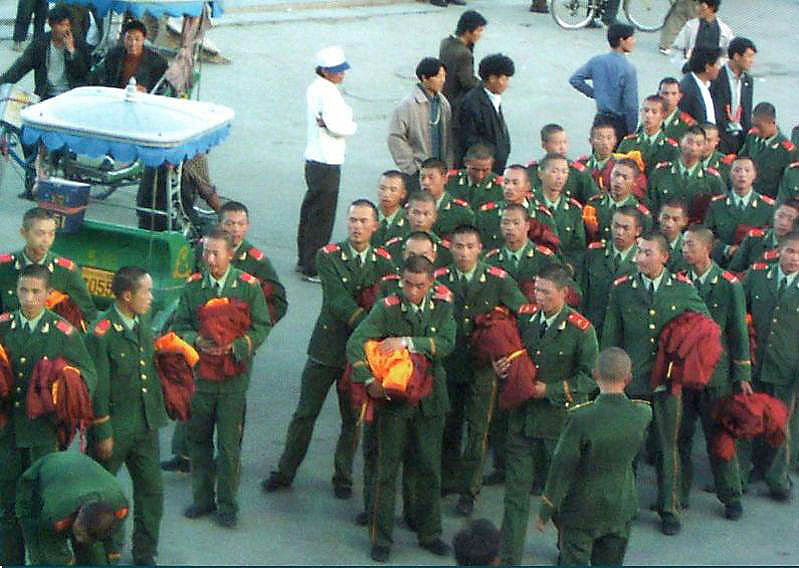
this photo has been making the rounds of various anarchist, marxist, and other far left sites, but hasnt been mainstreamed yet. apparently, it is chinese soilders dressing like monks, just before the recent violence.
i am liking these ny times slide shows. this time it is gloss on Wang Xizhi Watching Geese” by Qian Xuan, a chinese scroll paitning from the fourth century.
siggi eggerston is an icelandic designer and illustrator who deos slightly overly cute things with abstraction and pixelation.
world's evangelical congress talks about the jews.
fantastic story about time travel, as told in a wiki, wise, and v. v. funny.
window licker and my neck mash up works better then it should.
motel sign.com is a collection of photos of old motel signs mostly from the american west.

this one from montanna is one of my favourites.
more depressing information about teen incanrecation, including discussion of rape.
ivy leauge is a band that sonds like vampire weekend, but more self aware, and also kind of super awesome. links go to three mp3s.
more rats off Clintons ship.
army is apparently worried about the pyschological impact of soilders returning to the gulf, but not worried about it enough to egt them the fuck otu of there.

Ryan McGinley, 2008. It is a strange and moving image, with its combonation of protection, anxiety about intersections, and profound, eroticised intimacy. its the meloncholy and desire for attachment after the plauge y ears but not after the plague.
McCain apparently used the pretty violent language to emotionally abuse his wife:
Three reporters from Arizona, on the condition of anonymity, also let me in on another incident involving McCain's intemperateness. In his 1992 Senate bid, McCain was joined on the campaign trail by his wife, Cindy, as well as campaign aide Doug Cole and consultant Wes Gullett. At one point, Cindy playfully twirled McCain's hair and said, "You're getting a little thin up there." McCain's face reddened, and he responded, "At least I don't plaster on the makeup like a trollop, you cunt." McCain's excuse was that it had been a long day. If elected president of the United States, McCain would have many long days.
fascianting article on the connections between the early lds church and aum shinrikyo.
the virgina folklands series, like a lomax in a post digiital age, the link goesto a video of single line hymondy, gorgeuos.
contemparary art lol's.
Monday, April 07, 2008
i am working on this show about edmonton erotica, and one of the things about this kind of show, is that you begin to realise patterns of behaviour, the show is turning out to be sort of low key, whitmanesque, lots of portraits, with a couple or three exceceptions less fucking and more meta discussions about the gaze--which shouldnt be a suprise, but kind of is.
and then i saw juliens work, at his house today (one of the great things about being a curator is in the guise of work one can be nosy), and julien used to turn me on, literally, phyiscally, hard on short of breath, and i chose him to be part of the show as memory, more then anything--but meeting him today, i didn't have that phyiscal reaction, it sort of disappaited into something else, somewhere else. but the work got much stronger.
and i also thot he was a bit of flake, because i didnt get a ford drawing, that he promised, but that was a varagacy of the mail, not his fault or mine. i am finding his work more interesting, his painting better and his body less interesting, so i have this set of self portraits, tht i chose to be part of the show because they turned me on, or the memory of them turned me on, and now they are just excellent paintings.
and 30 or so self portraits, in a white t shirt, have an eroticised energy, they have a masturbatory delight in the self, and i dont have much work that is literally or figurtivley masturbatory.
but with juliens work, it will be two or three male artists working with nudes, or close to nudes, or have male energy...and theres another problem--he also has a set of military portraiture, extremely well painted, homosocial w/o being homosexual, work that tells secrets about what men do when women are not present...he showed one, giant (7x10) paitning oil on paper, of a soilder, shirtless, a crown of bullets, and guns at his feet, which in its working class fetishism, and the portrayal of flesh, the act of looking, has an eroticism, but i am not sure it is the same, as the work of the self portraits, andi t muddies the homosocialhomosexualwaters, which isnt a bad thing, and which is a realevent thing, or maybe its a bit of a mcguffin...
i want him in the show, and both works fit, but im not sure which i will chose.
and then i saw juliens work, at his house today (one of the great things about being a curator is in the guise of work one can be nosy), and julien used to turn me on, literally, phyiscally, hard on short of breath, and i chose him to be part of the show as memory, more then anything--but meeting him today, i didn't have that phyiscal reaction, it sort of disappaited into something else, somewhere else. but the work got much stronger.
and i also thot he was a bit of flake, because i didnt get a ford drawing, that he promised, but that was a varagacy of the mail, not his fault or mine. i am finding his work more interesting, his painting better and his body less interesting, so i have this set of self portraits, tht i chose to be part of the show because they turned me on, or the memory of them turned me on, and now they are just excellent paintings.
and 30 or so self portraits, in a white t shirt, have an eroticised energy, they have a masturbatory delight in the self, and i dont have much work that is literally or figurtivley masturbatory.
but with juliens work, it will be two or three male artists working with nudes, or close to nudes, or have male energy...and theres another problem--he also has a set of military portraiture, extremely well painted, homosocial w/o being homosexual, work that tells secrets about what men do when women are not present...he showed one, giant (7x10) paitning oil on paper, of a soilder, shirtless, a crown of bullets, and guns at his feet, which in its working class fetishism, and the portrayal of flesh, the act of looking, has an eroticism, but i am not sure it is the same, as the work of the self portraits, andi t muddies the homosocialhomosexualwaters, which isnt a bad thing, and which is a realevent thing, or maybe its a bit of a mcguffin...
i want him in the show, and both works fit, but im not sure which i will chose.

Thursday, April 03, 2008

From Der Speigel, Bush at an International Conference. (More context means I would have to speak German)
the present master mason in utah is lds. that they were banned for 60 years in the middle of the 20th century, and controlled the masons before hand, this is news.
Tata from India buys Rover and Jaguar.
Greenfield Saunders photos of iraq war veterans has this kind of blankness, and glamour that are found in his porn star work, and esp. his fashion work.
al jaffee fold ins, done digitally. (i could never get the paper ones to match up.
someone please buy me this
this utagawa show in brooklyn looks well worth looking at.

John Waters, Style and Glory, 2008, one of 6 manquettes comissioned for th Armory Show.
158 pages of Vigee Le Brun paintings, drawings and prints.
charles keeping's illustrations for Horned Helmet, are gorgeous, with a fluid line, and an approite ferocity (Vikings!) (other less exciting work as well)
MArylin Minter skateboard decks.
hockney 's thesis on camera and fine art, extends into cinema and politics.
all i am going to say about max mosley, is that after his five whores played nazi sex games, they got together for a nice cuppa. arendt and freud, together again for the first time.

Wikipedia photo for the Estate of Gregymog, in Wales.
atwood on anne of green gables including the fact there was an anime?!!
... our Office recently concluded that the Fourth Amendment had no application to domestic military operations. See Memorandum for Alberto R. Gonzales, Counsel to the President, and William J. Haynes, II, General Counsel, Department of Defense, from John C. Yoo, Deputy Assistant Attorney General and Robert J. Delahunty, Special Counsel, Re: Authority for Use of Military Force to Combat Terrorist Activities Within the United States at 25 (Oct 23, 2001).
Footnote, Yoo Document Two.

Batman and Wolverine, Unknown Artist, 2008
It's nice to have words on paper that prove the Bush Admin was delibrately, and efficently shredding the constution.
alice shershow's jewlery, themed around alaska, have a poltical edge, and a wisdom about material fetish, sourcing and politics, that extends them above just craft--but they are v. v. well crafted.
egg collecting and working class culture, as a felony, via the bbc.
11 installation shots of the nw Murakami show in Brooklyn, including some of a giant, abstracted sculpture, he calls Mr Pointy--one of a seires. That it came from LA suggests that the switch from east to west coast, and the imporantce of the pacfic rim has become finalised.

Rainbow Portrait, 1600, Phillips. (Look at the snake on her shoulder, the cloak filled with eyes and ears, how the lace on the back of the dress looks like moth wings, the floral motifs, how she is 20 feet younger, and how the rainbow has the pearlescent shine of the unicorn, this is Elizabeth as Gaia.)
Hockney moving back to Yorkshire, has made his work more epic, less human, more about landscape, almost northern romantic, and about the contstant vitality of realist paitning. he has donated Bigger Trees Near Warter, to the Tate Britian, and it is 40 by 15 feet, in a mosiac style.

Hammer Quiz (i am poor at it, getting none of them right)
Gouge and Bite, Pull Hair and Scratch:The Social Significance of Fighting in the Southern Backcountry from the journal of manly arts.
the influence of warhol on Easton-Ellis' Prose Style.
26 photos of soilder art on the barrier wall in Camp Buhering, Kuwait.
another KBR Rape Case.

I Love Cul De Sac, by Richard Poor.
Old Master, Modern and Contemporary Prints, Christies, London
Impressionist & Modern Art, Christies, London
- The usually hodge podge, 360 lots, which suggests a lets throw shit at the wall and lets see what sticks.
- Not divided by chronology, so Xiogang, Rembrandt, and Leger are within 10 lots of each other.
- Someone tell me that Xiogang is worth something artistically, just so i am not goin to keep thinkign im a racist.
- Two of Warhol Queens work, the purple one is 6k more then the Orange one, Two of Warhol Lenin's, The Orange one is worth 14k less then the black one.
- Large Chunk of Warhol bought in, including the jagger set.
- Twomblys 7 Poets and a Greek Philosopher for 7k is a steal.
- Ugliest Warhols (and they are ugly) dont match for the ugliest johns, which is just clattering.
- A Whole chunk of Hockney, mostly odds and sods, but a great Swimming pool litho from 78
- It's still silly that you can get A durer for under 500 quid
- Is chillida even sold in America? (like 20 here, all 1000-1500)
- Black and White Etchings by Basquit, called anatomy, from 1982, i really like these (18 peice for 90k, which means they will be split and sold for 10k per to people wanting their first basquits)
- Who buys these Picasso neo-classical things?
- Munchs woodcuts are alot gothier, northern romantic, then his paintings
- Ltos and Lots of Rembrandts labeled late impressions, which is all and good, but how latE?
- if i ever do a show or a book called great tits in western art history, rembrandt's gotta be in there
- 93 out of 360 bought in, including Warhol, Miro, Picasso, a collection of Millet prints intended for peassents, of peasents, an amazing corot of a tree, Rembrandt, Durer, and Visscher's Tabby, plus others
- highest lot is 201 Routlouff works, highest individual work is 201k for Munch's death scene.
Impressionist & Modern Art, Christies, London
- Usual Collection of Drawings and studies by famous french artits, vuillard, bonnard, le trec, etc--mostly noting only for their convention
- It's good to know that Renoirs Bronzes are as sentimental as his paintigns or drawings
- really low prices. none in the 6 figures
- five Chagall drawings bought in (i thot those sold regardless of the market
- Endless Bronzes by Dali and Cermaics by Picasso
- 6 withdrawn, 30 out of 153 Bought In, including a really nice Bonnard DRawing.
- It's an open, which should mean no bought in, and work sold for low amounts of money. (but work is being marked as bought in, so either i dont know the terms, or the terms have changed)
- Tomaselli is one of the few that has cottoned onto thef act that prints have a different purpose, they arent (though can be) collectors versions of paintings
- Lot's of classic names Lambrie, SAchs, Friedman, etc
- Two Cady Nolands, for 40k over their estimates, which means the estiamtes are low (she rarely sells her work at auction as well)
- Condo is the lastof the LESers from the 8-s to make cash
- who is Oehlen and why is he worth 265k?
- Over estimate on the Dana Schutz, who is a great painter, but will suffer for a while, while the market figures out what people will pay for her
- Slyvie Fluery for 8100, WTF?
- It's weird how a joke paiting or a cowboy or a nurse can go for more then a million, but the more conceputally difficult three man looking the same way, can go for 104, while not weird, but you would figure his work would go for more
- Great early 80s installation by Kelly for 229
- Decent, Mid Career Scully for 469, Better (though print not painting) black and white one for 39k
- Someone should writer an article about AVAF as a bubble phenom (Like Loeb, who;s work has literally decimated in price)
- Schanbel is awful, please make him go away
- I Think Aoshima is so great, because he takes the dread of the Godzilla/Little Boy Generation and makes it Optomistic, he looks with hope to the trees taking over the canyon, its much eerier then the required dread (great peice unsold)
- Fantastic Phototranser, in whispering, almsot neutral bones, greys and greens, just after the hoarfrost series, for 79k
- Cornell, who should be getting Warhol prices, sells for 39k
- Some really awful stella scribble drawings
- Caro and D Smith making coming back
- Has anyone written anything on judds 2d prints and multiples from the 80s?
- a couple of fantastic ramos works
- 56 out of 360 bought in, including work by Warhol, Minter (red lips and gems), Wessleman (hands and stilllife--really strong work), Friedman (zombie, a minimalsit, robotic white box), and a Miffy by Tom Sachs
- What we can learn from the 121 prints here (all but one sold, most above estiamte, none for crazy money), is that MAtisse was not a master print maker, a fantastic drafts man, but these are still drawings reproduced, not prints for the sake of prints (and there is only one true masterpeice, his st dominic from 1921
- Canaletto landscapes were much less popular, with some of the best examples bought in
- Gorgeous print of Jeromes study by Durer, not a later impression for a little over 6k
- Miro is still doing better then he should
- Two of the Minatour Rape, from the Vollard SEason, by Picasso in teh same auction, carless, (of course only one sells)
- A Decent Schiele for he steal price fo 14,9k
- Three Banksys bought in (yeah!)
- A Marini suite that made me think seh might be better then i hae credited
- Some Iconic Brushstrokes bty Lichenstien, make me think that work functions better as a one element on a small 2d surface
- Lots of Iconic Warhol, Soup Cans, Marlyins, Maos, Electric Chairs, from late and early (best work though, might be Sunrise, 1972, for its timely kitsch)
- prices out for the last 50 lots or so,

Wednesday, April 02, 2008
Tuesday, April 01, 2008
The Project Description: The restaurant at the Château Lacombe rotates. I want to invite a group of fellow artists and writers to dinner there, and put a video (VHS) camera on the lens. As the camera records for 60 minutes, the microphone will record the gossip and every day conversation of the participants. I would then want this video to play on a non-stop loop throughout the exhibitions run.
The Project’s Conceptual Underpinnings.
Like a circle in a spiral
Like a wheel within a wheel
Never ending or beginning
On an ever-spinning real
Dusty Springfield, Windmills of My Mind.
My grandmother died, and left me this camera, and I am about to leave Edmonton, back to Toronto. The camera is of a dying medium, difficult to get film for. The Lacombe has a kind of spectacled modernism of wealth and privilege that has now faded into something worn and a little sad. The restaurant rotates slowly; the only way that we can be sure that change has occurred is a slightly different kind of scenery. The circle of my life, with the cycle grandmothers life, with the leaving of a city and the death of a medium, creates a difficult web, combining it with a place which makes no progress, and is now home to high school proms, middle class wedding receptions, and other dress up events, while cycling on something that constantly moves, but never goes anywhere, has an intense psycho-geographic mark.
The work will take an hour to make. It is done in real time. It will be done as a way of remembering, of making real an event that was chosen as spectacle. Think of it as a pop trash recreation of Max Olphus infamous waltz scene in La Ronde (you know the one, it was stolen by Fosse in Cabaret.) The scene, and I hope this work, will be simultaneously ironic of sentiment, and heartbreaking in encapsulation of desire and loss. Also like Kiki and Herb, who manage to be strange, political, camp, and dismissive of camp, in their version of the Dusty Springfield I quote above. The work will have an edge of sentiment, but by only showing the world passing by, and not visually engaging with the participants, also a certain voyeuristic refusal of the camera’s mechanical gaze.
This becomes a camp 2.0, then, a desire to document everything, but to avoid the cameras, to circle about with pleasure, but to use that pleasure as a symbol of death, but only obliquely. The real cannot be returned to, it cannot be discussed directly, like a fish that becomes more slippery, the more one tries to catch it. What is real here—the meal, the documentation, the desire, the loss? What is hyper real, the bibliography of references in the second paragraph, the dark metaphors into the first, the stretching of an hour event into 2? What is surreal, making the private into public, making everything into theater?
This project then, wants to mess around, with Reel, like the dance, or Reel like what you put film on, or Reel like what you use to Catch fish, with Real like what has happened, with real, like what is factually accurate, with Real, like what can be ontologically proven.
The Project’s Conceptual Underpinnings.
Like a circle in a spiral
Like a wheel within a wheel
Never ending or beginning
On an ever-spinning real
Dusty Springfield, Windmills of My Mind.
My grandmother died, and left me this camera, and I am about to leave Edmonton, back to Toronto. The camera is of a dying medium, difficult to get film for. The Lacombe has a kind of spectacled modernism of wealth and privilege that has now faded into something worn and a little sad. The restaurant rotates slowly; the only way that we can be sure that change has occurred is a slightly different kind of scenery. The circle of my life, with the cycle grandmothers life, with the leaving of a city and the death of a medium, creates a difficult web, combining it with a place which makes no progress, and is now home to high school proms, middle class wedding receptions, and other dress up events, while cycling on something that constantly moves, but never goes anywhere, has an intense psycho-geographic mark.
The work will take an hour to make. It is done in real time. It will be done as a way of remembering, of making real an event that was chosen as spectacle. Think of it as a pop trash recreation of Max Olphus infamous waltz scene in La Ronde (you know the one, it was stolen by Fosse in Cabaret.) The scene, and I hope this work, will be simultaneously ironic of sentiment, and heartbreaking in encapsulation of desire and loss. Also like Kiki and Herb, who manage to be strange, political, camp, and dismissive of camp, in their version of the Dusty Springfield I quote above. The work will have an edge of sentiment, but by only showing the world passing by, and not visually engaging with the participants, also a certain voyeuristic refusal of the camera’s mechanical gaze.
This becomes a camp 2.0, then, a desire to document everything, but to avoid the cameras, to circle about with pleasure, but to use that pleasure as a symbol of death, but only obliquely. The real cannot be returned to, it cannot be discussed directly, like a fish that becomes more slippery, the more one tries to catch it. What is real here—the meal, the documentation, the desire, the loss? What is hyper real, the bibliography of references in the second paragraph, the dark metaphors into the first, the stretching of an hour event into 2? What is surreal, making the private into public, making everything into theater?
This project then, wants to mess around, with Reel, like the dance, or Reel like what you put film on, or Reel like what you use to Catch fish, with Real like what has happened, with real, like what is factually accurate, with Real, like what can be ontologically proven.
Subscribe to:
Posts (Atom)