Best Picture: Atonement
Best Director: Joel Coen and Ethan Coen
Best Actor: Daniel Day-Lewis in There Will Be Blood
Best Actress: Julie Christie in Away from Her
Best Supporting Actor: Tom Wilkinson in Michael Clayton
Best Supporting Actress: Cate Blanchett in I'm Not There
Best Original Screenplay: Juno
Best Adapted Screenplay: The Diving Bell and the Butterfly
Cinematography: The Assassination of Jesse James by the Coward Robert Ford
Film Editing: The Bourne Ultimatum
Art Direction: Sweeney Todd The Demon Barber of Fleet Street
Costume Design: Elizabeth: The Golden Age
Original Score: The Kite Runner
Original Song: "Happy Working Song" -- Enchanted
Best Makeup: Norbit
Sound Editing: The Bourne Ultimatum
Sound Mixing: 3:10 to Yuma
Best Visual Effects: Transformers
Best Animated Feature Film: Ratatouille
Best Foreign Language Film: 12 -- Russia
Best Documentary Feature: Operation Homecoming: Writing the Wartime Experience
Best Documentary Short: Sari's Mother
Best Live Action Short: Le Mozart des Pickpockets
Best Animated Short: Madame Tutli-Putli
Monday, February 04, 2008

I don't feel that it is necessary to know exactly what I am. The main interest in life and work is to become someone else that you were not in the beginning. If you knew when you began a book what you would say at the end, do you think that you would have the courage to write it? What is true for writing and for a love relationship is true also for life. The game is worthwhile insofar as we don't know what will be the end. My field is the history of thought. Man is a thinking being."
i sent the head master of sjsa an email two months ago, about what i wanted from him, and basically it was a seeking of information...of texts
its like something is seminal, and something so important, that you assume it is similarlly seminal, or the same for at least some of the people, that some people have shared that experince, that what made you isolated was equally isolating or equally negative for others...and everyone you touched base with even those who ran away, viewed it as a positive thing, and so it becomes more isolating more lonely
and what i want from coates is information, files, investigations, discourse, and i have this idea, that information (archives) brings truth--its a common myth, esp among people who create, analyse or taxonomize information for a living (or for what passes for a living)
so if these files do not find answers it will confirm those fears that hatch deep--that the seeking of information is futile...(my pysch records impregnanted this doubt in me)...so i wonder, then how do i go creating new systems of information, when information has proven so unreliable, so ready to misreading, when the fish can not be caught, why keep fishing? (and i think frankly, in a round about or complicated way, describes my isolation or exhaustion, and also my hope with the more logophillic examples of xianity and pyschological--the ambiguity and unreliabity of information systems as a way to assuage lonlienness explains my masochistic realtionship to both freud and jesus)
is this what derrida was talking about when he wrote a silkworm of owns own, the brianworms eating the ceberal cortex as mulberry, but how does one make thread from this?
- Truth, Power, Self: An Interview with Michel Foucault - October 25th, 1982.
i sent the head master of sjsa an email two months ago, about what i wanted from him, and basically it was a seeking of information...of texts
its like something is seminal, and something so important, that you assume it is similarlly seminal, or the same for at least some of the people, that some people have shared that experince, that what made you isolated was equally isolating or equally negative for others...and everyone you touched base with even those who ran away, viewed it as a positive thing, and so it becomes more isolating more lonely
and what i want from coates is information, files, investigations, discourse, and i have this idea, that information (archives) brings truth--its a common myth, esp among people who create, analyse or taxonomize information for a living (or for what passes for a living)
so if these files do not find answers it will confirm those fears that hatch deep--that the seeking of information is futile...(my pysch records impregnanted this doubt in me)...so i wonder, then how do i go creating new systems of information, when information has proven so unreliable, so ready to misreading, when the fish can not be caught, why keep fishing? (and i think frankly, in a round about or complicated way, describes my isolation or exhaustion, and also my hope with the more logophillic examples of xianity and pyschological--the ambiguity and unreliabity of information systems as a way to assuage lonlienness explains my masochistic realtionship to both freud and jesus)
is this what derrida was talking about when he wrote a silkworm of owns own, the brianworms eating the ceberal cortex as mulberry, but how does one make thread from this?
Saturday, February 02, 2008
Friday, February 01, 2008
the conservapedia on angel.
Sarah Silverman, Matt Damon, and Fucking.
beautiful incadenscent sculptures, sort of steam punky.

Francis, Oil on Linen, 2005, John Currin.
I like this one a lot more, because it seems less toxic in its irony and its misogyny, and it furthers the arguement that Currin is one of the great techincal painters of his generation. This is a great painting, northern european in its heritage, with a love and devotion clearly indicated. I wonder if i am projecting, because babies are cute, and because the babies (his baby, his son) softened him was such a culturally proper, heteronormative and seductive narrative. His pictures of his wife still have the icy surfaces and perverse heritage that he is famous for.
i really like these doc shots by Katarin Kurr, mostly of television sets. Teh one of the early morning show, indicaintg the stage mangaging of the domestic, is literal and painfully obvious, but making visual what was only assumed has its own power.
gorgeous retrofit of a water twoer, in Ulrecht, Netherlands. I love how it manatains the inherent utilitarian nature of the form, but still makes it liveable, super minimal, but v. v. pretty. Done by Zecc. (The black and white and grey might be a bit opressive though)

Here is a photo to the stairs to the bedroom.
i like this seasons collection of men and womens casual clothes, by Below the Clouds, a danish collective.
susan fauldi destroys the new book 30 women on hilary.
this doug saunders article on how norway and alberta treat oil revnue, is an exquisite peice of reportage, and does several fairly complicated things simultaneously. it confirms that the albertan ministry of energy is filled with morons, that the minister in charge is incapable of speaking well. It makes an oblique arguement that Trudeau was right, and that energy policy should be federal, it mourns for when the boom is over, it discusses how little energy we really get out of the oil sands, and it makes us albertans look like rural ninnies. it also argues strongly for old fashioned values that seem more and more nessc. including discipline, thrift, temeprerance, and long term planning. Norway will surrive. Alberta will not.
kind of hysterical article from the stage managment company who are handling the popes visit to DC
indie porn sweet, well composed, with a kind of joie d vire that is absent from other art or pro/am stuff. excellent mix of women and men, with some landscape urban work to set the scene. sort of a mcginley rip off.
can someone please buy me this small local church in Randolph Vermont. We could make it an Artists retreat!
martin parr selections from the bored couple set, from the mid 90s, amusing, wry, and bitter, i am suprised he got them to sign off.
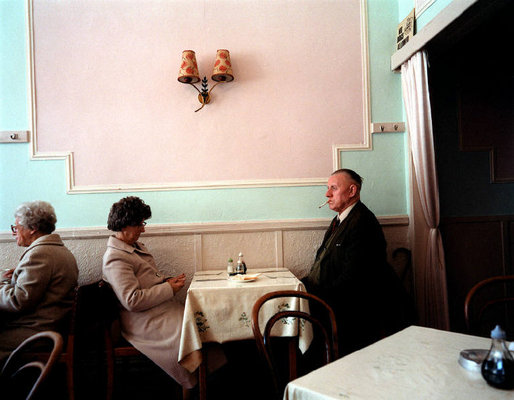
New Brighton, 1985
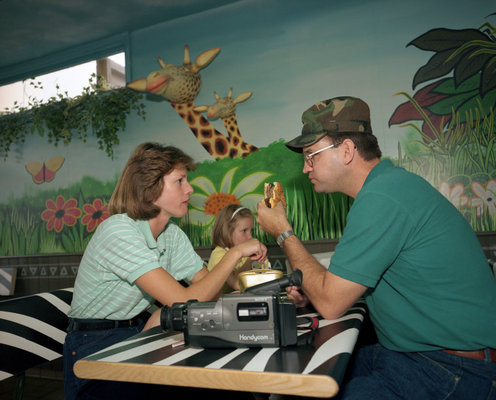
Windsor Safari Park, 1981
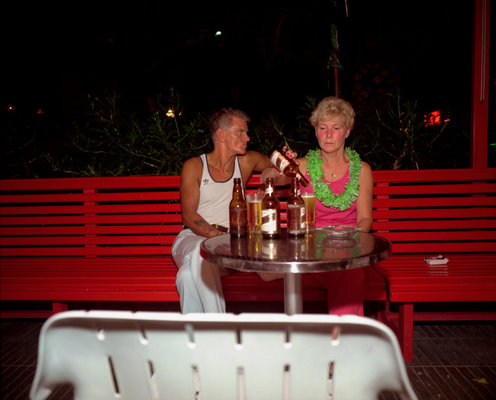
Majorca, Spain, 1993.
Mark Yuhina does lovely almost english illustrations of fly fishing, and offers to give a free painting to every person who brings a kid fishing. I love his colour sense, and the movement inherent int hese works, he is a biologist, and they have an interesting intersection between work for pleasure, for science, and for art.
itchy robot also does font shots.
field and stream illustrates the top 50 lures of all time--i like the folk design and thephotographic style, of this feature. They are also written in that high geek code that is impentrable poetry to those not initiates
love the colour on this poster, and how the pink foam sort of gobbles up the phrase for ever
mike mills new book fire works would function better as a series of prints.
outing at a large baptist church in DC:
One of Washington’s largest black Baptist churches was rocked by a female member of its choir who sent separate e-mail messages to the pastor in December and January outing more than 100 church members as gay, mostly male choir members.
stacey cambfield in Tennessee has filed a bill that would ban "any instruction or materials discussing sexual orientation other than heterosexuality" The link goes to a foto of the dude holding a conferdate values sticker.
ben funkhauser at 15, has found a venue to launch a scene in seattle--gives me hope.
Gen Caldwell allows US SOildersi n Iraq to blog, full text of the speech when i find it.
i am v. sad that this t shirt is sold out.
rachel denny makes me want to get the deer show back on track.
i love how formal and prickly these pencil sculptures, and how they almost swoop in places.
i dont know how to embded this but if you have a chance, watch it--aboug 15 minutes long, about an irish catholic priest named Jim Kelly, who found that his flock was mostly spanish speaking, largely ecudorian, and often with out papers. His work on behalf of them is one of the reasons why i am still loyal to the catholics,a nd an excellent example of xian service.

Conte, Carbon Fiber Spider, 2004.
He is known for his robotics, but this one has no automata.
and for he commentar below, his name is Robert Pollardi, and he did two series of them, one in 1985 and one 20 years later.
From 1985:
Salle D' Afrique.
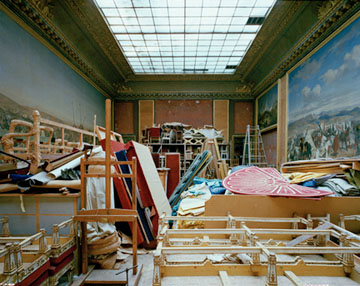
From 2005:
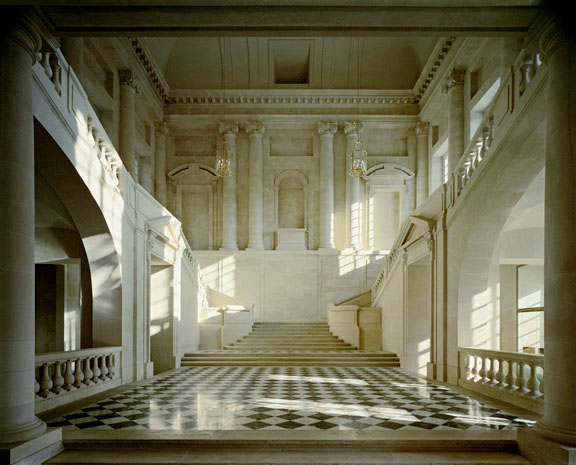
Escallier De Leure Gabriel.
I think in its refining, the later is more camp, but the first, from 1985, with its sort of luxurious chaos, and its colour sense, has a kind of disorder, which is almost anti Versailles. They are large, 10x10 or so. He also did large series on Chernobyl, New Orleans, Shanghai and Havana, which leads to reading of death of empires. The 1985 one also reminds me of The Destroyed Room by Wall.
more here
Sarah Silverman, Matt Damon, and Fucking.
beautiful incadenscent sculptures, sort of steam punky.
Francis, Oil on Linen, 2005, John Currin.
I like this one a lot more, because it seems less toxic in its irony and its misogyny, and it furthers the arguement that Currin is one of the great techincal painters of his generation. This is a great painting, northern european in its heritage, with a love and devotion clearly indicated. I wonder if i am projecting, because babies are cute, and because the babies (his baby, his son) softened him was such a culturally proper, heteronormative and seductive narrative. His pictures of his wife still have the icy surfaces and perverse heritage that he is famous for.
i really like these doc shots by Katarin Kurr, mostly of television sets. Teh one of the early morning show, indicaintg the stage mangaging of the domestic, is literal and painfully obvious, but making visual what was only assumed has its own power.
gorgeous retrofit of a water twoer, in Ulrecht, Netherlands. I love how it manatains the inherent utilitarian nature of the form, but still makes it liveable, super minimal, but v. v. pretty. Done by Zecc. (The black and white and grey might be a bit opressive though)
Here is a photo to the stairs to the bedroom.
i like this seasons collection of men and womens casual clothes, by Below the Clouds, a danish collective.
susan fauldi destroys the new book 30 women on hilary.
this doug saunders article on how norway and alberta treat oil revnue, is an exquisite peice of reportage, and does several fairly complicated things simultaneously. it confirms that the albertan ministry of energy is filled with morons, that the minister in charge is incapable of speaking well. It makes an oblique arguement that Trudeau was right, and that energy policy should be federal, it mourns for when the boom is over, it discusses how little energy we really get out of the oil sands, and it makes us albertans look like rural ninnies. it also argues strongly for old fashioned values that seem more and more nessc. including discipline, thrift, temeprerance, and long term planning. Norway will surrive. Alberta will not.
kind of hysterical article from the stage managment company who are handling the popes visit to DC
indie porn sweet, well composed, with a kind of joie d vire that is absent from other art or pro/am stuff. excellent mix of women and men, with some landscape urban work to set the scene. sort of a mcginley rip off.
can someone please buy me this small local church in Randolph Vermont. We could make it an Artists retreat!
martin parr selections from the bored couple set, from the mid 90s, amusing, wry, and bitter, i am suprised he got them to sign off.
New Brighton, 1985
Windsor Safari Park, 1981
Majorca, Spain, 1993.
Mark Yuhina does lovely almost english illustrations of fly fishing, and offers to give a free painting to every person who brings a kid fishing. I love his colour sense, and the movement inherent int hese works, he is a biologist, and they have an interesting intersection between work for pleasure, for science, and for art.
itchy robot also does font shots.
field and stream illustrates the top 50 lures of all time--i like the folk design and thephotographic style, of this feature. They are also written in that high geek code that is impentrable poetry to those not initiates
love the colour on this poster, and how the pink foam sort of gobbles up the phrase for ever
mike mills new book fire works would function better as a series of prints.
outing at a large baptist church in DC:
One of Washington’s largest black Baptist churches was rocked by a female member of its choir who sent separate e-mail messages to the pastor in December and January outing more than 100 church members as gay, mostly male choir members.
stacey cambfield in Tennessee has filed a bill that would ban "any instruction or materials discussing sexual orientation other than heterosexuality" The link goes to a foto of the dude holding a conferdate values sticker.
ben funkhauser at 15, has found a venue to launch a scene in seattle--gives me hope.
Gen Caldwell allows US SOildersi n Iraq to blog, full text of the speech when i find it.
i am v. sad that this t shirt is sold out.
rachel denny makes me want to get the deer show back on track.
i love how formal and prickly these pencil sculptures, and how they almost swoop in places.
i dont know how to embded this but if you have a chance, watch it--aboug 15 minutes long, about an irish catholic priest named Jim Kelly, who found that his flock was mostly spanish speaking, largely ecudorian, and often with out papers. His work on behalf of them is one of the reasons why i am still loyal to the catholics,a nd an excellent example of xian service.
Conte, Carbon Fiber Spider, 2004.
He is known for his robotics, but this one has no automata.
and for he commentar below, his name is Robert Pollardi, and he did two series of them, one in 1985 and one 20 years later.
From 1985:
Salle D' Afrique.
From 2005:
Escallier De Leure Gabriel.
I think in its refining, the later is more camp, but the first, from 1985, with its sort of luxurious chaos, and its colour sense, has a kind of disorder, which is almost anti Versailles. They are large, 10x10 or so. He also did large series on Chernobyl, New Orleans, Shanghai and Havana, which leads to reading of death of empires. The 1985 one also reminds me of The Destroyed Room by Wall.
more here
Camp 2.0
I keep thinking about what camp means to a generation who is assimilating, and doesn't seem to need it much anymore. I think about how it has become a parlour game, more then it usually was, or a trick of rhetoric, something that becomes historical positioning, taxonimizing and commenting on a parody of culture, which became the dominant way of thinking, a kind of culture itself. But the weird thing is, it seems that camp becomes a way (as it always has?) for us to save ourselves from heterosexism, from homophobia, and now from assimilating queers, who wish to put the strangeness and the impoliteness back into the closet. In works as diverse as Andrea Bowers AIDS quit installations, Rufus doing Judy at Carnegie Hall, Richard (Blank)'s ecent photos of Versailles, the poetry of Friedreic Sediel, the songs of Nellie McKay, the installations of Andrew Harwood and Ayllson Mitchell, Carl Wilson's 33 1/3rd Volume on Celine Dion, amongst others, asks and re-evaluates what camp is, and who it is for. It becomes Camp 2.0.
Outline:
What is Camp:
I keep thinking about what camp means to a generation who is assimilating, and doesn't seem to need it much anymore. I think about how it has become a parlour game, more then it usually was, or a trick of rhetoric, something that becomes historical positioning, taxonimizing and commenting on a parody of culture, which became the dominant way of thinking, a kind of culture itself. But the weird thing is, it seems that camp becomes a way (as it always has?) for us to save ourselves from heterosexism, from homophobia, and now from assimilating queers, who wish to put the strangeness and the impoliteness back into the closet. In works as diverse as Andrea Bowers AIDS quit installations, Rufus doing Judy at Carnegie Hall, Richard (Blank)'s ecent photos of Versailles, the poetry of Friedreic Sediel, the songs of Nellie McKay, the installations of Andrew Harwood and Ayllson Mitchell, Carl Wilson's 33 1/3rd Volume on Celine Dion, amongst others, asks and re-evaluates what camp is, and who it is for. It becomes Camp 2.0.
Outline:
What is Camp:
- Potted History of Sontag
- Critique of Sontag's history.
- Discussion of Barthes, Punctum and Theatricality/Artifice
- Can Punctum exist in a work that is mediated so deeply.
- What has happened to Camp, in the post Judy era, what was different and what has remained the same.
- Camp and the heremunitics of suspicion
- Camp and its realtionship to assimilation, camp's uneasy realtionship to mainstream gays (cf Mattachine society and its suits, Macho versus Fairy in the 70s, Stonewall's participants and difference, Discourse around the uses and abuses of the parade)
- Gay Male:
- the expecations, the assumption is that this is the culture that needs and uses camp most often.
- how do we use it, and when do we use it.
- Lesbian Female
- Drag Aesthetic and LEsbian Performance
- Radcylffe Hall
- Dolly Wilde
- Claude Cahun
- Gertude and Alice
- Highsmith (and Ripley as cross barrier)
- Pulps
- Terry Castle on the above
- Drag Kings
- How this history is used
- forgotten?
- Transgendered
- How does playing with gender differ from being?
- Camp as mark of gender fluidity
- The Case of the Cockettes.
- Performing Across Barriers of Gender and SExuality as a nessecary component of camp.
- Straight
- Decadence, Deviance, Performance, and Desire
- The Case of Nellie McKay and femminism on Mother of Pearl, (esp in the metajokes about senses of humor)
- The Case of Fredrick Segial and his Ducatti's.
- Rufus, Judy, and Gender
- Andera Bowers, Diseased Pariah, Taxonmies, and Reliquies in grey steel
- Carl Wilson, Celine Dion, Sentimentality, the Sublime, and the absence of gay voices.
- Versailles storage room:
- cosmetic
- Antoinette as Camp Icon
- Castle
- Coppala
- French pop
- Mitchell, homecraft, and Taste
- Harwood and the Femming of the Motorcycle
- Seidel and the Motorocycle
- Teh Motorcycle in GLBTQ history
- Then: Because it is expected of us
- Now: Because it is a skil that might atrophy unless it is used.
- Because it destablizes and refuses the expecations of standardizing discourse
- Because it estranges the pull towards political purity.
- Because it makes a complicated arguement against the large biological urges
- Because it reminds us that our history is against marriage and family (cf Lee Edelman Queer Theory and the Death Drive)
- because it is liberating
- because it is historicising
- Because it engages in the carnivalesque
- because as a culture, we have forgotten, with few exceptions the vitiality of the carnveisque (Bhaktin, obv)
- Because it allows to safely speak home truths.
- it still does this (cf McKellon as Dame)
- because it is fun.
- YEAH FUN.
- Differences b/w historical camp and camp now
- Attempts at defining camp and how they have failed
- Camp as a poltical force/protest force
- do people remember or is it important that camp is maintained
- the case study of the new cuddly, broadway safe john waters
- Failure at Taxonomizing and Definining Camp Historically
- How I failed here
- questions that are left to be answered
- is the term too large to be useful.
- is there anyway real difference
- why wont matt damon love me.
Tuesday, January 29, 2008
Other Things:
- Lunch with Joe
- Nina to meet Mark
- Lunch with Aaron
- Calgary Scheduling with Wil,
- Call Jason vis a vis SJSA
- Geez pitch (or Xtra) to the WInnipeg Nuptial
- Talk to the dude in Applachia about missed deadline and SF
- if SF is still a go
- Passport
- buy ticket
- book hotel
- join society
- rewrite the kenny peice
- figure out tech for it.
things to do in feburary.
talk to:
talk to:
- Talk to Ted (Close idea, Erotica update, Frames, Film Screen, Salon, Photos)
- Talk to Blair (Erotica idea)
- Talk to Elaine (Erotica Idea, Funding, and Placement)
- Talk to Steph (Erotica)
- Stephen (about collages)
- Rachels Contact about the Boxes
- Heather at Toronto Free Gallery about the Grid Show
- Mercer Union about the Grid show
- Rosedale, Knox Spadina Pres. Bloor Street United, Canadian Bible Society, Pres National ARchives
- Mandolin Books and Travel Alberta
- Rest of the Salon Folks
- Ashley
- Ann (Timelines, Cheque)
- Corb Lund
Install/Deinstall/Prints Made/Shipping/Etc:
Ford Show:
- Find Press
- Write Thank You Note
- Scan Collages
- Collate Addresses
- Mail work to Artists
- Follow up on Catalog
- Follow up on that one sale.
Ann:
- 10 Prints Made, Signed, and Numbered
- Box, etc made
Sugar Bowl:
- Shoot Images from 181
- Print images, in the same size and style that you made ted's images or talk to ted about what he wants to do.
- Install on the 20th
- Call Press about the show
Mandolin:
- Mylar:
- If no mylar, then mirrored frames
- drop off contract
- talk to her travel alberta dude.
Green Portfolios
- Call Type
- Follow Up with Ballenford Books
Curatorial Tasks:
- Confirm last three Grid Items
- Send Package to Galleries outlined in Email to Lorna
- Find Space for the Erotica show
- grant seeking for placement and the like
Writing:
- Long Camp Essay
- Blog Entry about Art in Toronto
- Cave 17 Entries on First Nation, Chuck Close, Abstract (cut and edit), Babara Rose, and Death of Photog Shows
- Cat Power, Dwight and Buck Reviews
- Alberta Vues
- Edit Poems
Exposure:
- Meeting on Feb 8th (confirm date)
- Visioning Meeting, so prepare brief statements on western night and film sieres to do.
Email:
- Photos to Lorna
- Thanks to David
- See/Vue about the Hidden Edmonton Column Idea
Monday, January 28, 2008

Toronto Font Shots
These photographs of signs are an attempt to listen to the city in all
of her moods. Literally, they talk about the patterns of commerce,
transportation, population, and politics, the neighborhoods that rise
and fall, the immigrant communities that grow and move. Moving from
City Center to its outer boroughs, I take photos of text that I find
intriguing.
Sometimes the font is interesting because of its decay, or its
homemade crude charm, and sometimes it is interesting for its
commercial power, and the design element is an important aspect of
this project. I think that signage is the place where those two meet.
But it is not only aesthetic.
When Rem Koolhas' new library was opened in Seattle, information
workers had to put up Bristol board to show valuable information,
including location of washrooms, directions outside, and to the
checkouts. Koolhas' masterpiece was a failure because he didn't get
fonts. I think that the mark of a living city then, is that
understanding. Toronto gets it, organically flowing through its
citizens. (Think of it as that lurid and lovely two page spread of
neon in Scott Brown/Venturi's Learning from Las Vegas, except that is
now mostly a graveyard, and the fonts of Toronto are birds in a
thicket.)
The five here are intended to mark a bit of a history, and they are
100 years old, so it is not only a question of aesthetics or
information flow. Combining the history of a city with its aesthetic
qualities strikes me as a project of psycho-geographic desire that an
architectural bookstore might be intrigued by.
Installation Notes:
I want to paper the foyer with 4x7 drug store prints of signs,
providing a visual reference to the overwhelming number of signs and
signals that one get from living in a city on a daily basis. By making
them appear nicely in rows, there is also an attempt towards making a
visual taxonomy.
These photographs of signs are an attempt to listen to the city in all
of her moods. Literally, they talk about the patterns of commerce,
transportation, population, and politics, the neighborhoods that rise
and fall, the immigrant communities that grow and move. Moving from
City Center to its outer boroughs, I take photos of text that I find
intriguing.
Sometimes the font is interesting because of its decay, or its
homemade crude charm, and sometimes it is interesting for its
commercial power, and the design element is an important aspect of
this project. I think that signage is the place where those two meet.
But it is not only aesthetic.
When Rem Koolhas' new library was opened in Seattle, information
workers had to put up Bristol board to show valuable information,
including location of washrooms, directions outside, and to the
checkouts. Koolhas' masterpiece was a failure because he didn't get
fonts. I think that the mark of a living city then, is that
understanding. Toronto gets it, organically flowing through its
citizens. (Think of it as that lurid and lovely two page spread of
neon in Scott Brown/Venturi's Learning from Las Vegas, except that is
now mostly a graveyard, and the fonts of Toronto are birds in a
thicket.)
The five here are intended to mark a bit of a history, and they are
100 years old, so it is not only a question of aesthetics or
information flow. Combining the history of a city with its aesthetic
qualities strikes me as a project of psycho-geographic desire that an
architectural bookstore might be intrigued by.
Installation Notes:
I want to paper the foyer with 4x7 drug store prints of signs,
providing a visual reference to the overwhelming number of signs and
signals that one get from living in a city on a daily basis. By making
them appear nicely in rows, there is also an attempt towards making a
visual taxonomy.
Sunday, January 27, 2008
Art often feeds on that which is passing away, and in doing so, assits its passage. In Britian, with its precipate deindustraliaztion , much of tradtional working class culture has now aquired a nostaligc patina, celebrated in the cliches of a film like The Full Monty, in which social collpase is recast as what is meant to be bitter-sweet comedy. Similary in Sensation, there were curse kokes, kebabs, tabloid spreads, figments of pornography, confessional and lurid peices--in short artists trying hard to behave badly . The mere form, the shadow of working-class culutrre, is cleberated but only in the grosses and most cliched outlines (of course its silly for anyone to object, because this art is so knowing, so ironic.) The solidatry that those forms prodced and were produced by is forgotten, and the result has only the appeance of life. So this vampristic art draws life from its already anaemic subject. (233)
Pastoral , says Empson, can give expression to a critique of social injustice, at least in a limited way, since the exceuluded or those who have alittle of no stakje in society has less to risk by relatiing some hume truths about it. Now it has to be said that in Britian art thjat criticises social injustice has been thin on the ground for some years...but nevertheless contrempary pastoral art has conrained a critrique of the way things are, not so much in the wider society, as in the art world. The snobishness, cant and false high seriousness of the art world is at least implicitly criticised by an art that uses the form of high art to relay obsecnties, crudities and the detrius of modern urban life . Such art makred a sharp rejewction of hiugh theory, of the elite and autonomous concerns of art, and of the comventional pities of these artsits beloved byt he art establishment..( 252-3)
High Art Lite, Julian Stallabrass, Verso, 199.
brutalist architechture pool on flickr.
i really want this bearded man poster by keith shore, his combo of macho boys and twee aesthetic has a queer charm
a man has a bet where he has to spend a month at the bellagio.
21 condom wrappers including the amazingly named devils skin.
fantastic scrabble qoutes from the 50s onwards.
i really want this bearded man poster by keith shore, his combo of macho boys and twee aesthetic has a queer charm
a man has a bet where he has to spend a month at the bellagio.
21 condom wrappers including the amazingly named devils skin.
fantastic scrabble qoutes from the 50s onwards.
Thursday, January 24, 2008
This is her breakdown record, like Judy at Carnegie Hall, like Lou Reed with Berlin, like Bowie during Low . . . the only problem with the analogy is that this one is so dissociative, while they were hyper-aware—her voice is lost perilously in noise, production effects, and chaos. There is a too-easy metaphor there, and when you reach for it, your heart breaks with the brittleness of it.
Anthony Easton
Fort Saskatchewan, Alberta, CANADA
Village Voice, Pazz and Jop, 2007
Fort Saskatchewan, Alberta, CANADA
Village Voice, Pazz and Jop, 2007
Paragons
New Abstractions From the Albright Knox
i have kept an eye on the Knox for a while because their interests in abstraction, and Edmonton’s have a close history, in fact their weather, their industrial core, their general isolation, and even in a sort of poetic way, their relationship to major centers of culture, make Buffalo fairly close to home. (ie
Their aesthetic and their relationship to modernism all have a distinct parallel. They both took to modernism very early, and left it very late. Non representational abstraction was popular in both capitals long after it became personae non grata elsewhere. Greenberg was visiting
Now with a recent upswing in interest in abstract forms (ie the 2006 show at the AGO about Colourfield, the Truitt and Louis Retrospectives in Washington, Amy Sillman on the cover of Art Forum, and all along the Queen Street Strip dozens of painters working thru colour and form just like they used to, I wanted to see what was new about it vis a vis the Albright Knox, Edmonton has failed to keep with abstraction, they have not collected widely or deeply the new work that are near them, even with the oil money flowing in and a new building that will cost in the tens of millions. If this slight show, full of artists who are all basically post Warhol, tells us so much both about where non representational art is heading and where it has been.
Whoever coordinates acquistions for
What is in there, though, is often difficult, often brilliant, and absolutely gorgeous, with 15 works by 15 separate artists, all working through the edges of what formalism, and abstraction can mean, there is a history here, and a tenderness towards material, not so much a fetish towards materialism, as a long, loving seduction, a marriage that refuses to end. Quick run thru of the work in question:
David Baechlor. He wrote the defense of decorative and cosmetic, Chromophobia, a book that is one of my favourites, and a book that has deeply influenced what I thought about art in general, and my practice specifically. In one page he decimated the minimialist narrative of purity, talking about how Flavin’s use of white was not pure, and how his use of colour was explicit—how it pooled around the cold cement of gallery floors: “(Flavins) work was more often than not made in pools of intermingling coloured light : red blue green orange yellow and white” (Chromophobia 12) Here, he took Flavin’s colours and medium (fluorescent tubes in purple, yellow, orange, plus green) and used them in a highly localized context. Called The Spectrum of Hackney Road, the tubes are hidden under ready made dollies, the rough dun coloured wood hiding and reflecting the flourscents, the floor slick, like rain sodden ashplat, the only way that one can see the work is thru reflection, misdirection…like a flanuer moving around the city, like how broken glass used to be called Cockney Diamonds. The work is abstract because of this reflective, it is a highly concentrated, highly formalist, meta-work, about seeing, and colour and about living in cities.
Tim Bavington—huge painting, 11 feet long and more than 5 feet high, a stripe work, starting with greens, with a middle of pink on black, and ending with orange on orange, sort of like creamsicle on crush. He grew up in
Andy Collins weak work, black lines intersecting a mild field of sage and cream, polite, and slick. A Dentists Office Mangold.
Karin Davie—Neo-op painter, with those loops of muddled colour, oranges, blacks, browns, and yellows. Choleric. The most interesting thing about the work in question ,and the thing that I wouldn’t have noticed unless I saw her work live (And I have seen her work in reproduction several times, is that the work is very explicitly messy, there are drips, trails of paint into other lines, awkard transitons in the top of the loops, places where the works have been painted again, radical changes in brush stroke---its not quite gestural, and I keep wondering looking at the painting that was shown here, if the work was sort of a working out of what it meant to be an op artist, and like their work, it functions much more cleanly as a repro then a painting, (cf Rileys paintings in the mid 60s, vs Rileys prints). I like that shock of the messy, of the unpure, and I think the painting in a way that makes one wonder if the reach has exceeded the grasp is a bug and not a feature. (That the work is titled Pushed, Pulled, Depleted and Duplicated #7 suggests that printers terminology is v. much in her mind)
Jim Ismerman
It wasn’t one on the floor, waiting to be rolled around like some kind of toy. V. much about his craft aesthetic, and about his reclaiming high and low, the weaving was tight, and the foam core underneath was invisible, it was well crafted, and crafted in such a way, that you knew that his concern was a sort of showing off, a way to indicate how good he was at the manual dexterity required to (hand) braid something that large, that seamlessly.
Jim Lambie
It’s a leak painting, and I like anything that explicitly makes fun of the drip process, or the automatic writing fetish that comes thru with so much gestural abstraction. 6 plastic shopping bags, nailed very low to the wall, almost touching the flour, with 6 v. small lines of paint leading to a puddle on the floor—a humble, witty work, not only about gestural abstraction, but also about the workaday markmaking that occurs when we move about, in the kitchen leaks for example. They are so low to the floor, because they are meant to be about where the bag would be if carried home---in the hanging then, it becomes performative, or at least becomes the working thru of performance. I also like the pun of low, hanging low on the wall, hanging low on the arm, low to the ground, low as in hi/lo populism—the performative and the abstract, attached to walking, was v. similar to the Baechlor, and it was a nice theoretical matching, which susggests that Lousi GRachos, the curator was doing his job.
Roxy Paine:
Made by a machine, so t he work is the building of the machine and not the painting in question, and I think that showing the machine in progress would have been a more interesting show then showing the after effects of the machine---what I said about drips and Lambie applies here—though the fact that it reminded me of Whipped Cream and Other Delights made up for something.
Sue Williams
The reason why I went to the show really, and I am glad I finally saw a work of hers. It was as naughty as I was expecting, and as polymorphus, how a leg moves to look like a ducks webbed foot, how a arm becomes a streak of red, and the like—but the thing that amazed me was how careful it was, I always thought her work would be much messier then that—it is all carefully, almost drawn, the mark making delicate, and highly sophisticated, so that there is no splatter, and for example the drying of paint is attached to the opening of a white space. The colours—teal, crimson, peach, salmon, lemon, almost clashed, and their was no attempt to lead the eye—it was a cacophony of competing forms—which worked, because the unprimed linen canvas (normally brown) was painted a thick, creamy white, before the figures went on—the tension b/w the colours, the lines, and the shapes only pushed farther the tension between representation and abstraction in her work.
ChanSchatz
Two Artists, one Japanese, one American, both born in 1968, painting on silk. The tonal similatiries between the silk and the paint, the slickness and sheen of one and the other, were incredible, that it contained almost 40 colours (including everything from dusty rose to scarlet, from aquamarine to emerald, from swimming pool aqua to navy plus black and white), shapes blossoming and falling apart, and large s paces where nothing was happening except the taut fabric, suggests a intertextual historical envisioning—I could see wyld style graffiti, murakami esque backgrounding, anime landscape, English garden textiles, Japanese paintings on linen, kimonos, vasserly op art and others. This was a painting I could have spent hours looking at—and with the sheen of the silk, the reflection of the acrylic, and the utter (super) flatness) a painting that was so slick to be impossible to reproduce.
Mariko Mori
Her work, when it does not feature her, is sort of formless SF kitsch.
Lisa Stefenelli
Red abstraction, built up, like a pyramid, with plenty of white space, using delicately placed, and sinuous lines—arabesque and Arabic, reminded me of the painting nad decoration schools relationship to Arabic calligraphy, and how the long awaited revival (at least by me) of their work and their people will come to fruition—Its good that younger artists are paying attention to this work.
Jessica Stockholder
Standard Cady Noland assemblage, unsure why people considered it abstract at all.
Joesph Maroni
Green on Green, lots of building up layers, lots of dropping, like a morris louis as a monochrome, the surface tension between the rising of various green tones, and the scuttling on the last third of the painting, indicated an excellent technical painter, and that he is working on board makes the work seem much more rigious for some reason—overjoyed that the work is modest, 4x3, and that he has not moved into the 20 foot giant paintings of doom, what works as small and intimate on this scale becomes a tedius disaster on a large one.
Rachel LEckowitz
Red bumps rise t o the middle of the canvas, almost like latex, obviously fleshly, and sexy/creepy in a david lynch parasites taking over the body kind of way—actually one of the few artists that reminded me of flesh, and the only artist whos work confused sculptural and painterly conventions. One of them is just the latex, the other has stripes, that look like a circus tent, or something worse—I was really unsettled at the power of them. Held their own, in a quiet way, against the poppysch overdose by chenshan.
It’s worth a trip to Scarberia, though you missed the shuttle bus, and really an excellent tiny sequal to their under looked, and historically important Extreme Abstraction show from 2005
Wednesday, January 23, 2008
Voters sense this truth. It’s an observable fact that those voters who care most deeply about equality – deeply enough to organize their lives to live in egalitarian communities – overwhelmingly vote Republican.
Take a look at a map of the state of Missouri. A recent study conducted by the state identified a dozen of the state’s 114 counties as “equality centers.” These equality centers were located on the outer fringes of St. Louis, Kansas City, Columbia, and Springfield. Every single one of these highly egalitarian areas of the state voted overwhelmingly Republican.
Meanwhile, the most unequal parts of Missouri, the cities and especially the city of St. Louis, voted heavily Democratic. Where you find many different lifestyles and races; where you find singles, immigrants, and gays; where you find high-rise buildings, country estates, and really great take-out – there you find inequality. After all, what is inequality but another form of “diversity”? And what is “equality” but another word for homogeneity? Communities with lots of married families, lots of single-family homes, and low proportions of nonwhite minorities and single people – communities that Democrats and liberals would inwardly disparage as “white bread” – are communities in which people tend to earn similar amounts of money. (DAvid FRum, Comeback Conserativeism, p. 37)
Tuesday, January 22, 2008
The best thing about this video, is how it subtly alludes to how lesbian rumours were used to tititalte and degrade MA, and how the erotic, lesbian spectacle of MA's life was attached to her idleness, her cash, and her tennous realtionship to her father, from the beginning to post WWI. Castle writes about it in The Aspirational Lesbian.
| |||||||
 | |||||||
| | |||||||
| 1 cup cooked long grain or basmati rice 1 cup whole milk 1/2 cup heavy cream 3/4 cup coconut milk 2 ounces sugar, approximately 1/4 cup 1/4 teaspoon ground cardamom 1 1/2 ounces golden raisins, approximately 1/3 cup 1 1/2 ounces chopped unsalted pistachios, approximately 1/3 cupIn a large nonstick saute pan over medium heat, combine the cooked rice and milk. Heat until the mixture begins to boil. Decrease the heat to low and cook at a simmer until the mixture begins to thicken, stirring frequently, approximately 5 minutes. Increase the heat to medium, add the heavy cream, coconut milk, sugar, and cardamom and continue to cook until the mixture just begins to thicken again, approximately 5 to 10 minutes. Use a whisk to help prevent the cardamom from clumping. Once the mixture just begins to thicken, remove from the heat and stir in the raisins and pistachios. Transfer the mixture to individual serving dishes or a glass bowl and place plastic wra | |||||||
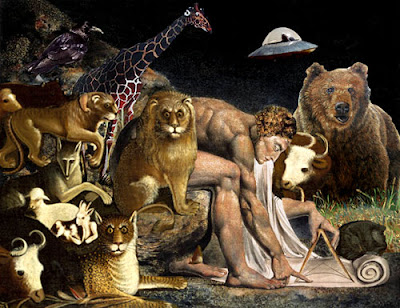
t it took me a while to get over my obsession with paper, with making prints, with framing things in terms of paper...i kept thinking about this in realtion to a work by sally mckay. at first i loved it for the negative black space, for how it collapses to the middle, the punctum of the giraffes neck or how the lion stares out at the viewer.
there are other things, the mysticism that occurs when order is created, the similar visual obsessions that we share, including the peaceable kingdom, blake, s/f kitsch, and also how "real" (ie photographic) and the "fake" (ie drawn or painted).
but when i had lunch with her a couple of weeks ago, she told me that it did not come from scissors, i thot that it came from paper, and was scanned, but it came digitally, and has never been printed, so it was a combined reproduction of a set of reproductions, intended as a sketch, to be shown on the web, as a predecessor' for a larger installation work. but that one image has an added profundity, by the empheraml nature of the web, and also the kind of updating of the future that occurs here.
Subscribe to:
Posts (Atom)