ie
readymade:

r mutt, fountain, urinal, 1913, remade 1967

man ray, Cadeau (Gift), c. 1958 (replica of lost 1921 original)
painted flat iron with row of tacks, heads glued to bottom

Picasso, Bullhead, i dont remember the date

Giovanni Anselmo, Untitled, 1968, Lettuce, Copper Wire, Granite
(when the lettuce rots, the granite block falls)

Carl Andre, Suculus, Western Red Cedar, 1980 (this was a bit of a cheat, because he cut and compiled these)

Koons, New Hoover Convertibles, 1987

Hirst, The Physical Impossibility of Death in the Mind of Someone Living
1991
Tiger shark, glass, steel, 5% formaldehyde solution
assemblage:

Meret Oppenhiem, 1936, My Nursemaid
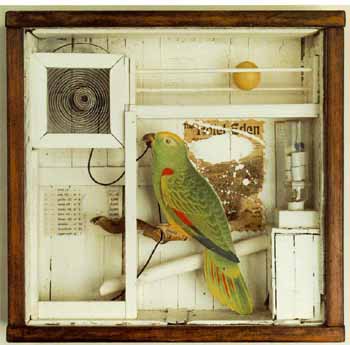
Cornell, Hotel Eden, Assemblage, 1945

Jasper Johns, Target with Plaster Casts, 1955
(same year as Rbergs infamous goat)

Louise Nevelson, Dawns Wedding I, Painted Found Wood, 1959
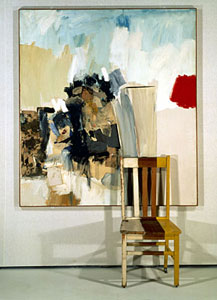
R Rberg, Pilgrim, Combine, 1960

Ed Kienholz, Portable War Memorial, 1968
(this might be my favourite material list ever:
Edward Kienholz. 1968. The portable war memorial. Plaster casts, tombstone, blackboard, flag poster, restaurant furniture, photographs, working Coca-Cola vending machine, stuffed dog, wood, metal, fiberglass)

Sarah Lucas, Au Nauteral, 1994
reclamation:

Warhol, Silkscreened, assembled plywood, 1969 (also see piles)(is this a goof on minimalism?)
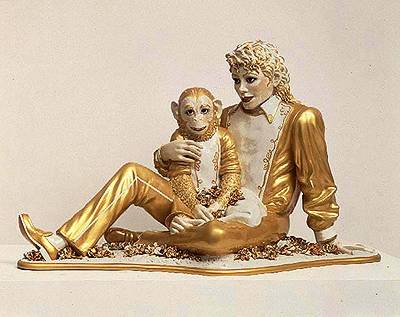
Koons, Jackson and Bubbles, 1989 (which is a reclamation of craft, kitsch, the baroque, pop, and gild/guilt, and which cannot work as a single entry, Robert Rosenblausm essay about Koons and his mirror work, has a lesser impact, b/c RR is unwilling to engage the formal implications of the 3rd form) (also, the moral severity of the made in heaven sieres would be lessened if it didnt recall/reclaim catholic polychromed sts as ikons of new protestant morality)

My Lonesome Cowboy, Murakami, 1998
From the Walker: "Dave Hickey, writing for Artforum in December 1998, compared the baroque extravagance of My Lonesome Cowboy to Gian Lorenzo Bernini's Ecstasy of Saint Theresa." (hes talking about how bernini uses space, how he commans the centrality of a large architechtual overwhelming, and returns it to one ecstatic figure, whos' vertical movement suggests xtc, its also obv a referent to anime, and western exoticism of oreintalism

Michael Graves, Team Disney Building Burbank, 1991

4 of 8, Dwarf Head, Sillicon, 2003, Paul McCarthy

Phillip Stark, gnome stools

Rachel Whiteread, Untitled, 16 Spaces (again, a reclaiming of minimalism, and also extending a neuman idea, these are sillicone, nauman was plaster)
Pile:

Eva Hesse, Right After,” 1969
more floating then piling, but like fred sandblack, the implication of falling and then piling is vital (and that the 3rd dimension is implied via the absence of object, the presence of space, light, etc, that its hinted at)

Richard Serra, 1968, Untitled, Rubber

Andre, Equivalent VIII 1966, Firebrick
(this one is interesting, b/c it is the same as his copper/steel floor peices, but the 3d means something, i just cant quite figure it out) (and placing it w. the serra, it has a really interesting discusion of the movement of the late 60s avant, because serra went from humble, almost impercetiple peices on the floor or as drippings, etc, performance/installation works to something else)

Felix Gonzales Torres, Public Opinon, Untitled (Public Opinion), 1991.
Black rod licorice candy, individually
wrapped in cellophane (endless supply), ideal weight, 700 pounds,
dimensions variable. (i want to talk about this peice a bit more on easter)
others:
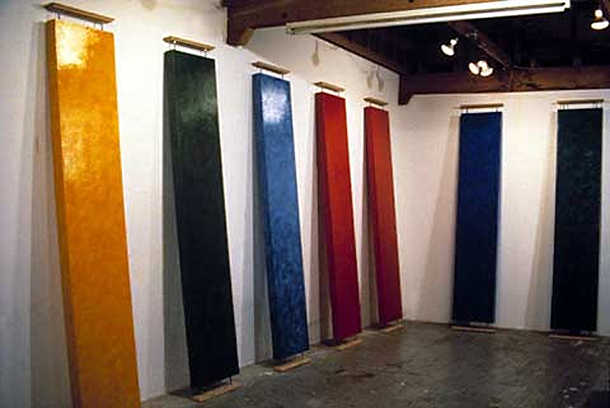
John McCraken, Painted Planks, conintuing (the postioning of the planks are the only thing that maek the work 3d, hung on the wall, traditionally as paintings, they would be minimalist releifs)

Thisi nstallation shot, of three colourfields, with Ann Truitts Summerfiled, in the foregrond makes my point for me, her realtionship to the washington colourfield school, her work moreo n painting then sculpting, even her banal shapes, make her a painter, or an anthologist of colour'sfunction rather then smoeone who caresabout shape in a space (perhaps?)
judd
there could be a million i could qoute here, if you read this blog, you should know what a judd looks like, that judd refused to call his work sclupture, that he placed them on walls, or made the sides the same, that he sabotoged and constructed his 3 dimensionality at the same time, suggests the radical displacement most 3d work had in the history of the 20th century
notes:
i know i cherry picked here, and i could have made as much of a 20th century list, of people who sculptued in more traditional ways, and surrived (ie but not limited to jacob epstein, hans jean arp, hepworth, moore, caro, smith, etc) but i think the point is, that it wasnt that 3d was eclipsed by 2d but 3d refused the label of sculpture, or at elast bucked under it

6 comments:
Hey. I think I was here a couple of years(?) ago. Found my way back after your comment at studiosavant.
I can appreciate your list of important artists working 3D in the 20th C. My opinionated quibble is that their pieces are, almost to a one (excepting those named near the end), mere illustrations or working models that demonstrate some pre-determined, contrived, not very profound concept. I like ideas well enough, but not when they're weakly veneered onto an armature that looks poorly.
Of course, there are plenty of crafters - ice sculptors and sand sculptors and owl carvers and the like - who take up the slack. But serious artists who are intent on sculpting artworks that stand up to historical precedents like ancient Egyptian or Greek sculpture, or a Donatello, or a Rodin, such artists are very rare.
But I'm glad to have come across the ripples resulting from casual conversations with good people like Rev. Joe. Presuming I'm not assuming too much.
its the modernist version of clem calling artists who worked in traditions aside from him, novelty artists. i dont think that the ideas that are presented here are "re-determined, contrived, not very profound concept", i think johns taking his body part literally as a discussion of what those in power do to all of our bodies, and esp. queer bodies, is a profund, disturbing, and well v. real idea, or warhol making objects to sort out what objects meant in a late capital culture, or the idea that art is constantly renweing or depleting depending on history, source, artist, and personae, like torres, etc are ideas that have currency, are not working models, but something harder to grasp.
as for the late minimals, andre, judd, etc i think they are working models, but working models about formalism, and what makes art, and how we become artists in the age of mechinchal reproduction, and what the crush of history has for us (which is closer to twombly, but still)
and as for koons, i dont think that someone who functons and deconsturcts so many aspects of art history, political capital, morality, sex, pleasure, childhood, etc could be considereed anything but radically renewing.
as for murakami, its fun and fuckable, and connected much more corepally(sp) then anything caro or hepworth did (fun and fuckable are two categories we need more of not less of)
and i think that donatello isnt the goal, i think standing up to life magazine or the national enquirer are much more vital.
and also, i think that michael jackson and bubbles can stand up to anything in the late baroque
I didn't think I dissed the outsider artists in my earlier comment - there's always a chance that good things will be made by self-trained, naive or hobby artists. Just as there's a chance I'll make something good if I keep at it, inspite of extensive apprentice and university training, accumulated knowledge, and commitment to art as a life's work.
Your comment about Johns' target piece is one thing, the target piece itself is another entirely. I can understand how one might obliquely arrive at such conclusions, but cannot agree that they are present in the work in any visually apprehendable way. Which is what I was getting at with "veneered armatures" - this is not intended as a mean jab, but as honest a description as I can find of how the accepted rhetoric actually suits the made object. I've not seen this Johns' work in person, but have encountered other works of his that I liked and even thought were good.
The minimalists have made some good work. The art historians have completely obscured what's good about it.
Koons hasn't made a single good thing, in my opinion, and in his case I'm tempted to throw out all the work along with all comments about it (baby/bathwater).
This comment may go on forever.
Fun and fuckability, sure. But what's missing even more is art. We've got enough design to kill a planet, and as I tried to point out earlier most of the images in this post are of objects heavily designed to deliver a specific meaning to the detriment of what they actually look like. And, on top of that, I generally don't think the objects deliver their intended meanings very well at all. 30-second TV ads do a better job of selling me an idea than most of these; which either confirms that these artists are/were in the wrong line of work, or that their work has been misrepresented by gallerists and historians and critics and auctioneers, or that I'm a sucker.
i wonder if you have to be queer to see the johns like that, but i v. much as a man who has sex w. men, saw that the pathologalicaztion of the body was central to that work, more central then what ever o(bleak) point that the modernist painters were working on at the same time (Johns at least did it w/o the funding of the CIA)
i think that sometimes the open and ambigious ideas are as impt, as the work, i can cop to that, and i can also cop to the fact that i find the work gorgeous, every peice there, whether it is intended to be or not, i find has an impt visual component, and koons is the rubicon, if you can find any value at all there, then you can go elsewhere.
and i think, that having to know a little bit about the peice, allows for it to be loved, regardless of the work (the gonzalez torres peice, now that its easter, is a godo example, that there areseveral versions of that, some of which are the same weight as he and his lover, and when depleted everything goes away, and some of which are renewed, says so much to me about family, and love, and the complications of death, and everytime i think of it i cry a little, no matter how much i love noland, i dont think ive cried at his work)
talk to me a little about how you think i am using minimalism, how you use minimalism, and how we should use minimalism?
as for the line b/w design, craft, etc i refuse to acknowledge it, i called it 3D for a reason, i take a modified walt whitman/frank o hara view of the difference b/w art, design, craft, found object, etc that most likely comes from how i take pictures, or that might be a snake that eats his own tail...
Post a Comment